








You’ve probably noticed in movies or television shows the ways in which directors take steps to let audiences know the kind of environment in which the stories are being told. The visual aesthetics are key.
For example, when audiences see a dreary environment, with armed troops patrolling civilian streets, and a giant banner of a strongman leader is unfurled, resting on the front of a government building, viewers immediately recognize the kind of story they’re about to be told: This environment is a totalitarian dystopia.
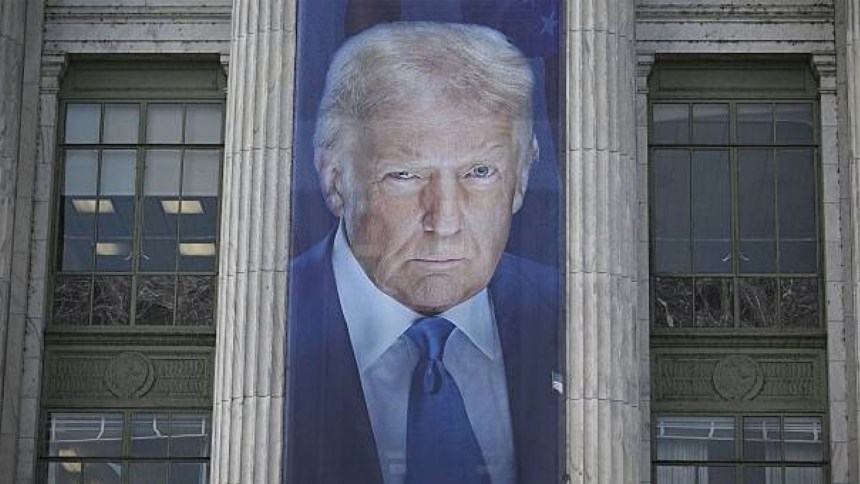
With this in mind, MS NOW reported Thursday on the latest addition to the façade at Main Justice:
A large banner with Donald Trump’s face was hung on the front of the Justice Department headquarters in Washington, D.C., the president’s latest effort to imprint his personal brand on the nation’s capital.
Observers spotted the lengthy blue banner featuring Trump’s face sandwiched between two pillars on the building’s exterior on Thursday. The banner, which also includes the DOJ seal, states, ‘Make America Safe Again,’ and adorns the front entrance of a department that Democrats say has been weaponized by Trump.
In a written statement, Trump’s DOJ acknowledged the developments, saying: “We are proud at this Department of Justice to celebrate 250 years of our great country and our historic work to make America safe again at President Trump’s direction.”
To be sure, images like these might seem familiar. In fact, The New York Times noted that large banners of the incumbent president now hang from multiple federal buildings in the nation’s capital, including the Agriculture Department and Labor Department, “in a bold statement of power and influence over the government.”
The obvious problem is with the nation’s increasingly authoritarian president embracing a fascistic aesthetic, not only in his choice of self-glorifying wall decor, but also in related administration messaging, coupled with the deployment of federal soldiers onto civilian streets.
But the newly installed banner at the DOJ took on a greater significance given the broader governing context.
In the post-Watergate era, both parties embraced a model in which the Justice Department maintained a degree of independence from the White House. The unfurling of the banner on the DOJ’s façade was a timely reminder that the wall between Trump and the federal law enforcement department has fared about as well as the walls of the East Wing.
Indeed, the banner was helpful in removing a pretense that no one took seriously anyway. The DOJ’s official statement was explicit and unambiguous: The department works at “Trump’s direction” — as opposed to the direction of the attorney general, who’s supposed to lead federal law enforcement.
But I’m also reminded of a column written by the Times’ Jamelle Bouie in August:
The administration-produced imagery in Washington is, then, a projection of sorts — a representation of what the president wants reality to be, drawn from its idea of what authoritarianism looks like. The banners and the troops — not to mention the strangely sycophantic cabinet meetings and news conferences — are a secondhand reproduction of the strongman aesthetic of other strongman states. It is as if the administration is building a simulacrum of authoritarianism, albeit one meant to bring the real thing into being. No, the United States is not a totalitarian state led by a sovereign Donald Trump — a continental Trump Organization backed by the world’s largest nuclear arsenal — but his favored imagery reflects his desire to live in this fantasy.
Six months later, Bouie’s observation still resonates. The DOJ banner doesn’t signal Trump’s strength — it reflects his desperation.
A failing president wants to convey authority, so he and his team scramble to impose symbols like these on the public. They appear intended to convey questions Trump seems reluctant to ask out loud: “Don’t I appear imposing? Isn’t it clear how powerful I am? Shouldn’t my opponents feel an overwhelming sense of fear?”
The answer to the questions, however, is “no.” In fact, members of Team Trump have it backward: By trying too hard, their posturing delivers the opposite of the intended message.
The Justice Department’s banner, in other words, doesn’t show a commanding figure; it shows a flailing politician pretending to convey confidence and strength.
