











Expectations heading into this week showed projections of about 55,000 new jobs being created in the United States in January. As it turns out, according to the new report from the Bureau of Labor Statistics, the totals exceeded those expectations. CNBC News reported:
Job growth was stronger than expected to start 2026, providing some relief to concerns about the state of the U.S. labor market.
Nonfarm payrolls increased by 130,000 for January, compared to the downwardly revised growth of 48,000 in December, and above the Dow Jones consensus estimate for 55,000, according to seasonally adjusted figures the Bureau of Labor Statistics released Wednesday.
The unemployment rate edged lower to 4.3%.
In general, a top-line total of 130,000 would been seen as a relatively good number — not extraordinary, but not bad, either. The preliminary total is being seen as a sigh of relief, however, in part because of low expectations, and in part because job growth over the last several months was even worse.
But while the new report wasn’t a disaster, it’s only a small part of a larger picture: The February report from the BLS is unique because it includes revised data from the entire previous calendar year.
And on this front, the new data is quite brutal.
What would ordinarily be seen as a good month for job growth represented the entirety of the year.
Previous estimates showed that the U.S. economy generated 584,000 jobs in the first year of Donald Trump’s second term, which was deeply discouraging. In fact, if we exclude years in which the economy fell into recession, the preliminary data showed that 2025 was the worst year for U.S. job growth since 2003.
Now, however, the picture is far worse: The newly revised, final data shows that the U.S. economy added only 181,000 jobs in 2025.
Here’s a chart showing job growth by year since the Great Recession, with red columns representing Republican administrations and blue columns representing Democratic administrations.
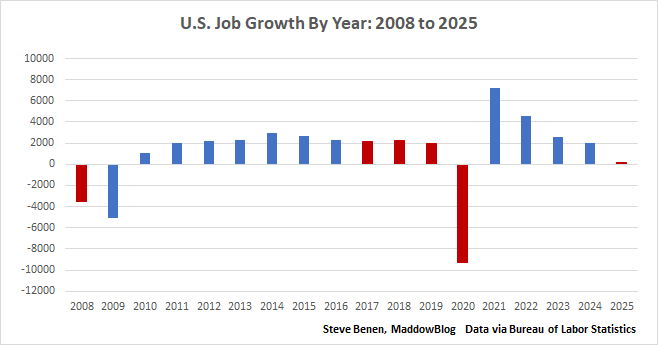
That small red column on the right side of the image? That’s 2025.
In other words, what would ordinarily be seen as a good month for job growth represented the entirety of the year. Indeed, in the final month of Joe Biden’s presidency, the economy created 237,000 jobs, more than entirety of the year that followed.
What’s more, we now know that in four months last year, the U.S. economy actually lost jobs — the first time this has happened since the Great Recession.
This week, the president peddled a familiar boast, insisting that he’s responsible for creating “the greatest economy, actually, ever in history.”
That was bonkers for a variety of reasons, but the new jobs data makes the claim look even worse. Indeed, the question for Trump and his White House team is simple: If Trump has created the greatest economy in history, why did American job growth slow to a 16-year low after he returned to power?
This post updates our related earlier coverage.
