








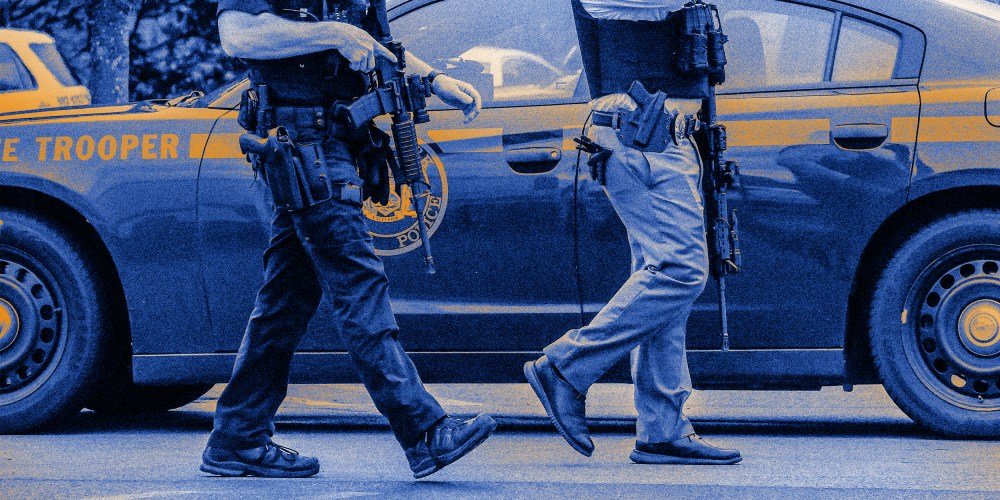
Louis Dekmar, the police chief in LaGrange, Georgia, is trying to change the way his department shoots people. According to The Washington Post, Dekmar isn’t changing the deadly force policy or the type of firearm issued or even trying to reduce the number of times his police officers shoot. He’s trying to change what body parts they aim at. The chief is training his officers to, when possible, shoot at the legs, pelvis or abdomen, rather than the prevailing law enforcement protocol of aiming for “center mass.”
What the chief is doing may get even more people killed — including his own officers.
Dekmar, who has led the department in the town of about 30,000 people for 26 years, means well. He wants to reduce the number of shootings by police that end in fatalities. But meaning well and making sense aren’t the same thing. In this case, what the chief is doing may get even more people killed — including his own officers.
Dekmar has a reputation, according to The Washington Post, for championing the unorthodox and being on the front line of progressive policing:
In the late 1990s, he instituted mandatory audio recordings of officer-citizen interactions. In 2004, he began sending his entire force to crisis intervention training so that everyone would know how to de-escalate encounters with people affected by mental illness. In 2009, he purchased body cameras for his officers, and in 2017 he made national headlines for apologizing for his agency’s role in a 1940 lynching.
The chief is by all accounts a professional who prioritizes the best interests of the town’s residents and the members of his department. That’s why it’s surprising that he’s training his officers to do something that undermines public safety and officer safety and may result in more shootings and more death, which is the opposite of what he’s trying to achieve.

Dekmar didn’t come up with the “shoot to incapacitate” idea out of thin air. He visited Israel in 2004 on a police exchange and saw officers there aiming for legs and hips, The Washington Post reported. For the next 10 years, he traveled to other countries where he learned of similar practices, likely by highly trained tactical and anti-terrorism units. Now, he’s understandably motivated by the continued unrest in the United States over police shootings.
Dekmar is right about the need to think differently about police use of deadly force. Each year in the U.S., almost 1,000 people are killed by the police, and Black people are up to six times more likely to die at the hands of a police officer. But Dekmar’s attempt to turn a gun, an inherently deadly weapon, into something less than lethal is wrong for at least three reasons.


First, only the wealthiest municipalities in America might have a budget that would allow for the kind of training, re-training and skill maintenance needed to teach officers to successfully aim at and hit smaller targets under specifically identified circumstances. Ammunition has become prohibitively expensive and increasingly difficult to find; increased time at the firearms range takes officers off the streets and can drain overtime budgets; and training officers on the controversial new method would require finding instructors who could first learn it, then do it.
Regarding Dekmar’s proposal, The Washington Post reported: “While such a policy might be supported by the public, explained John B. Edwards of the Peace Officers Association of Georgia, most agencies would find it impossible to implement.”
Dekmar is right about the need to think differently about police use of deadly force.
Second, even if unlimited training budgets abounded, the luxury of aiming at stationary targets in firing range conditions simply doesn’t exist on the street. Police are trained to resort to deadly force when they cannot contain or mitigate an imminent threat. That often means that all hell has broken loose, sometimes after a car chase, a foot chase, a wrestling match or all of the above. Aiming at someone’s leg or foot takes time and control, and if you have those, then you’re likely not facing an imminent threat to your life. And in those instances, officers should be using less-than-lethal methods, like stun guns or physical control holds, to subdue someone.
Third, “shooting to incapacitate” will likely lead to more shootings, not fewer. If officers are taught that their gun is now a less-than-lethal option, they could use that gun more and simply say, “I only shot him in the leg.” The imprecision caused by the reality on the street — when adrenaline is pumping, sirens are blaring and hearts are racing — would surely cause police firing rounds at appendages to miss and strike innocent bystanders. Shooting to wound, rather than to neutralize a threat, would also make it more “OK” for officers to use their guns in situations that don’t warrant it. Importantly, their failure to neutralize a deadly threat would mean more officers dying at the hands of violent subjects who survive their wounds and continue to attack.
As well-intentioned as “shoot to incapacitate” might be, it is a distraction from identifying and addressing the steps needed to reduce the number of shootings by police. We should be recruiting and training officer candidates who have the capacity to de-escalate potentially violent encounters through well-proven verbal techniques. We should be vetting police applicants to find those who are less likely to default to violence, racially driven biases and extremist ideologies. And we must hire officers who look more like, and better understand, the communities they are assigned to protect. Reducing the number of fatal police shootings is a worthy goal, but “shoot to incapacitate” misses the mark.
