








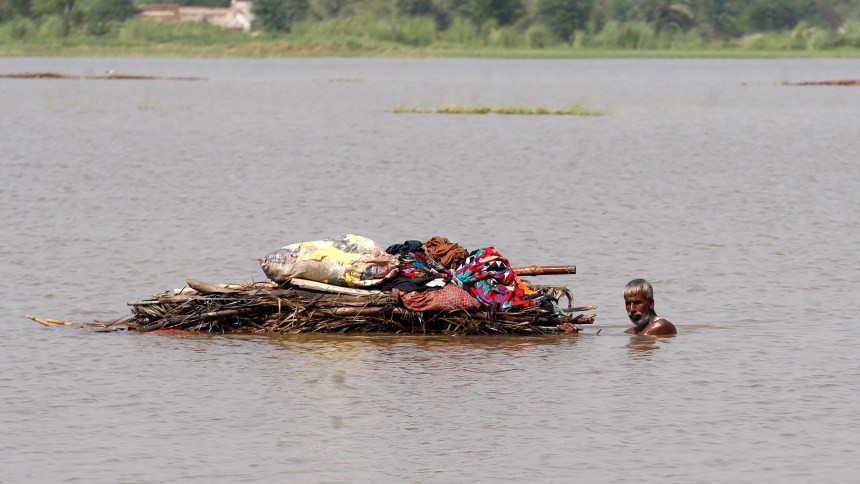
A third of Pakistan is submerged, an area tantamount to the size of the United Kingdom, as the country suffers devastating floods. Around 33 million people are displaced (roughly the population of California, the most populous state), and over a thousand are dead. Images show children sleeping on rags on the floors of government buildings after having watched their homes get demolished and, in some cases, loved ones die.
Were the entirety of the U.K. submerged, the global outcry, the fear around the impacts of climate change and the humanitarian response would likely be entirely different beasts.
Why, then, has the world not mobilized a humanitarian response equivalent to that for Ukraine — where, incidentally, around 12 million people have been displaced, or around a third of the number in Pakistan?
The uncomfortable answer is: racism.
Were the entirety of the U.K. submerged, the global outcry, the fear around the impacts of climate change and the humanitarian response would likely be entirely different beasts. Deprioritizing crises that affect Black and brown people might make them more tolerable for the industrialized world in the short term, but it is a surefire way to amplify climate-related fallout in the long run, making the world more violent and less inhabitable for all of us.
Some might say that war has a more mobilizing effect than natural disaster, but compared to Ukraine, the humanitarian crisis ensuing from conflict in Ethiopia, for example, is on a much larger scale but has gotten far less attention and assistance. Policy experts such as Lee Edwards, a London School of Economics professor of strategic communications and public engagement, identified the double standard exposed in the global response to the Ukraine war, noting that “Britain’s post-humanitarian response [of easing visa conditions for Ukrainians] clearly maintains a racialized state.” Tedros Adhanom Ghebreyesus, the director-general of the World Health Organization, also drew attention to the double standard revealed by the Ukraine crisis. “I need to be blunt and honest that the world is not treating the human race the same way — some are more equal than others,” he said. “And when I say this, it pains me. Because I see it.”

Invasions, occupations or humanitarian crises affecting brown and Black people, unfortunately, simply do not garner nearly as much compassion and urgency, which translates to less action to mitigate deadly events.
The industrialized world’s comparative apathy for places like Pakistan in a climate catastrophe can be defined as “climate colonialism,” Foreign Policy explains in a piece that makes the argument for “climate reparations.” The cruel reality is that countries that have contributed most to the climate crisis will be hit the least hard and vice versa, so industrialized countries must take responsibility.


Seventy-four of the world’s poorest countries, which contributed to less than 10% of global greenhouse gas emissions, will be the most devastated by climate change, the World Bank cautions. U.N. Secretary-General António Guterres warned that South Asia is a “climate crisis hot spot” (recall the unprecedented, life-threatening heat waves across the region in May), where deaths from climate catastrophes are 15 times more likely. The rainfall in Pakistan this year is 87% higher than the national average, Climate Change Minister Sherry Rehman noted, and this year is a climate harbinger for the country; it can expect more to come. Pakistan remains one of the most vulnerable countries when it comes to climate change, according to the Global Climate Risk Index.
Seventy-four of the world’s poorest countries, which contributed to less than 10% of global greenhouse gas emissions, will be the most devastated by climate change.
Industrialized countries like the U.S., China and the U.K., three of the biggest contributors to climate change, therefore, have a moral imperative to provide substantial financial assistance to countries like Pakistan, both in terms of humanitarian aid when crises hit and investments in more climate-resilient infrastructure so these countries are less devastated when such catastrophes strike. This is the underlying premise of “climate reparations.” However, rich countries’ financial commitments to provide assistance to poor ones in the Paris climate agreement remain severely underfunded.
There is a practical case for climate reparations, too, even if countries cannot be compelled to mobilize on moral grounds alone. In the next 30 years, the climate crisis could displace over a billion people, inevitably leading to multifarious security threats around the globe. Karachi, with a population of more than 16 million, is the 12th most populous city in the world. And some climate projections see the city being swallowed up by rising sea levels over the next 40 years, the noted Pakistani journalist Hamid Mir warned in an op-ed for The Washington Post. Mir argues that climate change is a bigger threat to the country than terrorism, a global focal point for Pakistan, as the climate crisis may deprive the country of tens of billions of dollars a year.
I would add that climate change and terrorism are also linked. The kind of devastation Pakistan has been subjected to in recent weeks may make it more prone to extremism: “[N]on-fulfillment of basic economic, political and other social needs of people have acted as safe havens for the extremist ideology holders,” a paper on extremism across the country, published in the Journal of Politics and International Studies, explains.
Any meaningful attempts by the global community to manage climate change cannot maintain the aforementioned racialized order. Continuing with the status quo, dehumanizing tragedy in the poorest countries, will make the biggest crisis facing humanity even less manageable.

Noor Noman is a writer focused on culture, race and LGBTQ issues.