


When Elon Musk sent a cryptic tweet to his 120 million followers telling them to “Follow 🐰,” it was immediately celebrated by QAnon followers as a sign that Musk is an Anon, a member of the conspiracy community. The flurry of momentum was one more indication that Americans’ conspiracy fever hasn’t broken — it’s just being stoked by a new QAnon hero.
It’s not clear whether Musk believes what he posts or if he just feeds on the attention controversy brings. He suspended several journalists from Twitter this week with no warning and little explanation, and has tweeted warnings about apocalyptic or population collapse, called for Fauci’s prosecution and mocked gender-diverse pronoun usage.
Musk’s white rabbit tweet has breathed fresh life into a QAnon movement looking for a new messiah in a post-Trump moment.
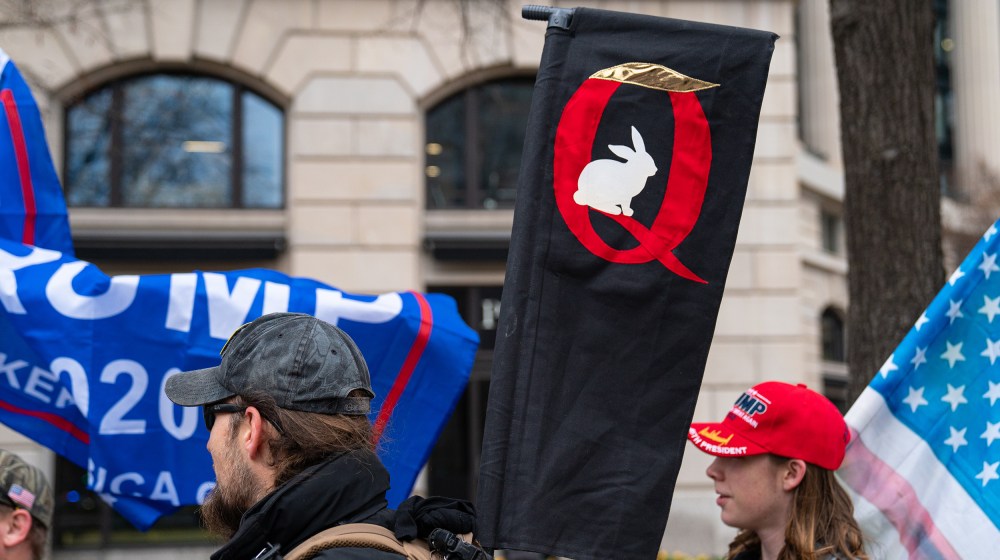
“Follow the white rabbit” is an allusion used by QAnon members to both “Alice in Wonderland” and “The Matrix,” and evokes a fantasy awakening to a world that lies beyond our own. It is a phrase regularly used by QAnon followers and “Q,” their mysterious leader. In the context of Twitter’s reinstatement of previously-banned QAnon accounts, Musk’s white rabbit tweet has breathed fresh life into a QAnon movement looking for a new messiah in a post-Trump moment.
Over the five years since it first burst onto the conspiracy scene, QAnon spread rapidly across the country and to dozens of nations, eventually making its way into mainstream conservative politics. Various polls show that some 15-20% of Americans believe at least some of QAnon’s core premises. That figure is even higher for conservatives and Republicans.
As a reminder, QAnon became an integrated part of the pro-Trump MAGA world through false claims that prominent Democrats were part of a cabal of pedophile elites and were plotting against then-President Donald Trump. But its growth was spurred by the retweeting and sharing of QAnon claims by Trump and QAnon supporter and U.S. House of Representative member Marjorie Taylor Green. So as Trump’s popularity declines, it’s no surprise that so many QAnon adherents are embracing the perception of support from a new celebrity — Twitter owner Musk.

Tweets like Musk’s are the perfect fuel for an online QAnon world driven by a scavenger hunt, puzzle-solving culture aimed at uncovering the “Truth” by decoding bread crumb-style “Q drops.” Those breadcrumbs have typically been posted as cryptic messages by the anonymous Q, but Q has posted only sporadically since Trump lost the 2020 election. Now, some QAnon believers think that Musk will be “posting Q drops to millions of normies,” as one QAnon adherent put it.
Many of Musk’s recent tweets borrow from the QAnon playbook, as Sara Dorn argued in Forbes this week, especially related to child sexual exploitation, which is a core part of QAnon’s mythology and its ideas about an orchestrated child-pedophile, Satan-worshipping ring run by a cabal of Hollywood and political global elites. Among other tweets about pedophilia, Musk recently appeared to insinuate that Twitter’s former head of trust and safety, Yoel Roth, was in favor of child sexual exploitation.


Whether he believes it or not, it’s a dangerous game to be playing. Roth and his family were forced to flee their home in the wake of Musk’s tweets. They had good reason to be worried: QAnon has already inspired and mobilized significant violence, including murders, as well as abductions or kidnapping plots of children, often by parents who believed their children had been taken away by Satan-worshippers or pedophiles. QAnon supporters have repeatedly threatened or attacked multiple sites believed to be child trafficking locations (including a Tucson cement plan, the Hoover Dam, and the National Butterfly Center). QAnon beliefs about a coming “storm” drove thousands to the Capitol on Jan. 6, and apparently underpinned a massive coup plot in Germany that led to the arrests of 25 individuals.
Many of Musk’s recent tweets borrow from the QAnon playbook, as Sara Dorn argued in Forbes this week, especially related to child sexual exploitation.
Trump hasn’t exactly gone away, although his role as the primary celebrity figure helping amplify QAnon messaging may be diminished. Just since spring 2022, he has shared more than 130 posts from QAnon accounts on his Truth Social platform, including images of himself wearing a Q lapel pin and a video with a song central to the conspiracy. The Anti-Defamation League described Trump as offering “increasingly explicit endorsement of QAnon” in ways that dangerously legitimize a violent movement calling for antidemocratic goals.
Passing the torch to Musk, who now has considerable control of arguably the largest social platform at his disposal, makes a certain amount of sense. It’s now Musk whose QAnon-adjacent tweets are challenging democracy. Musk has undertaken a strategy that destroys what the philosopher Jason Stanley calls the “shared democratic information space” by “nurturing the spread of mass suspicion.” It’s an all-claims-are-equal approach that lends legitimacy to false claims, disinformation and conspiracy theories by allowing them to coexist with vetted scientific expertise and peer-reviewed knowledge.
All of this makes it abundantly clear that QAnon and its conspiracies aren’t over. On the contrary, it’s likely that we haven’t even reached the peak of the kinds of political violence and hate that is undermining democracy from within. Musk’s embrace of the conspiracies that drive that violence is dangerous and irresponsible, and we can’t afford to ignore it.
QAnon adherents liken the idea of following a rabbit to a kind of awakening. In the real story, Alice actually did wake up. We can only hope that Musk — and the millions who listen to him — does the same.

Cynthia Miller-Idriss is an author and expert on extremism.