


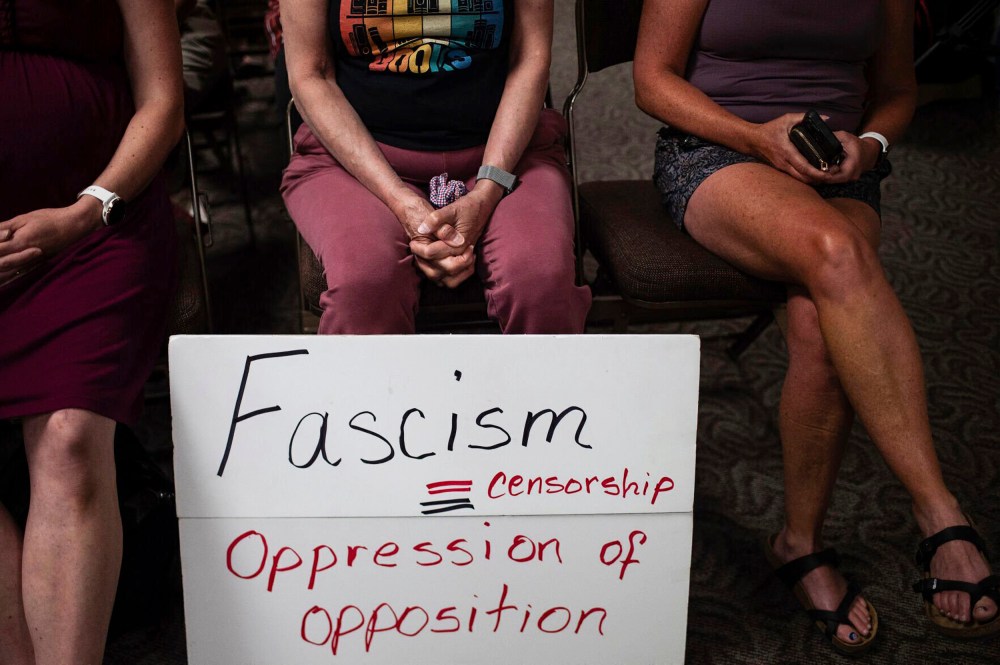
This week the American Library Association released preliminary data showing a “record surge” in challenges to books in public libraries. The group found “695 attempts to censor library materials and services and documented challenges to 1,915 unique titles” from January through August. That’s up 20% from the same reporting period in 2022. And the ALA documented the most book challenges last year since it began tracking them over 20 years ago. According to the library association, “The vast majority of challenges were to books written by or about a person of color or a member of the LGBTQIA+ community.”
The numbers serve as evidence that right-wing censorship is growing more sweeping and becoming more systematic. It becomes clearer by the day that this is a political movement that doesn’t just shun intellectual freedom but fears it.
The ALA’s numbers are most likely a significant undercount, because it’s drawing only from news stories or from reports filed directly to the association by concerned library professionals; a lot of challenges are likely not reported. A challenge may result in a book’s being retained, restricted or removed from circulation altogether. Those challenges may not always succeed, but the uptick speaks to intensifying efforts.
Removing a book from a public library is a more radical act of suppression than removing a book from a school library.
Particularly striking in the ALA report is the detail that public libraries now account for almost half of challenge requests. In 2022, challenges to books in public libraries — versus school or university libraries — accounted for 16% of documented challenges. During the first eight months of this year, they’ve accounted for 49%. It’s not clear what’s driving that shift, but the implications are serious.
Banning books at public libraries affects not just children but also adults — Toni Morrison’s and Margaret Atwood’s books are routinely challenged across the country. And removing books from public libraries is a much more radical act of suppression than removing book from school libraries. Setting aside for a moment the merits (or lack thereof) of right-wing censorship requests at school libraries, it’s fair to say school libraries warrant some degree of special scrutiny, because they’re tied to state-sponsored pedagogy for children. But public libraries, while sponsored by state funding, should be institutions of expansive intellectual freedom.


Public libraries are the sole means by which some communities can access books, periodicals and research resources. Libraries should curate their selections based not on popularity of ideas but on the principle of allowing people access to a wide spectrum of ideas. These challenges are coming from activists who want to narrow the spectrum of acceptable ideas to conform to a reactionary worldview. Mostly it appears that these activists are concerned about literature that showcases progressive social inclusiveness. And the fact that, according to the report, part of the uptick in censorship is being driven by people making requests for bigger numbers of titles to be censored suggests that censorship activism is becoming more organized.
The ALA isn’t the only watchdog that’s seeing an uptick in attempts to ban books. The free speech group PEN America recently published a report that found that school book bans and restrictions in the U.S. rose 33% from the 2021-22 school year to the 2022-23 school year. The report says the removals were spurred by “misleading rhetoric,” and PEN America, like the ALA, found that book bans overwhelmingly “target books on race or racism or featuring characters of color, as well as books with LGBTQ+ characters.”
And this all comes as libraries are becoming the sites of increasingly confrontational activism, including Proud Boys’ disrupting reading hours and activists’ directing death threats at librarians.
What’s chilling about these developments is that they suggest that calls for censorship in response to so-called woke culture aren’t just MAGA rhetoric or confined to Gov. Ron DeSantis’ Florida but are actually being put into operation by right-wing activists nationwide. The data suggests this is not something that’s going to go away on its own. It has to be faced by counter-activism — the left must recognize the cultural significance of libraries and defend the principle of intellectual freedom and multiculturalism in those spaces.
Libraries are supposed to be places where people go to open their minds. If some people want to keep their minds closed, then that’s their right. But they shouldn’t impose such ignorance on the rest of us.

Zeeshan Aleem is a writer and editor for MS NOW. He primarily writes about politics and foreign policy.