






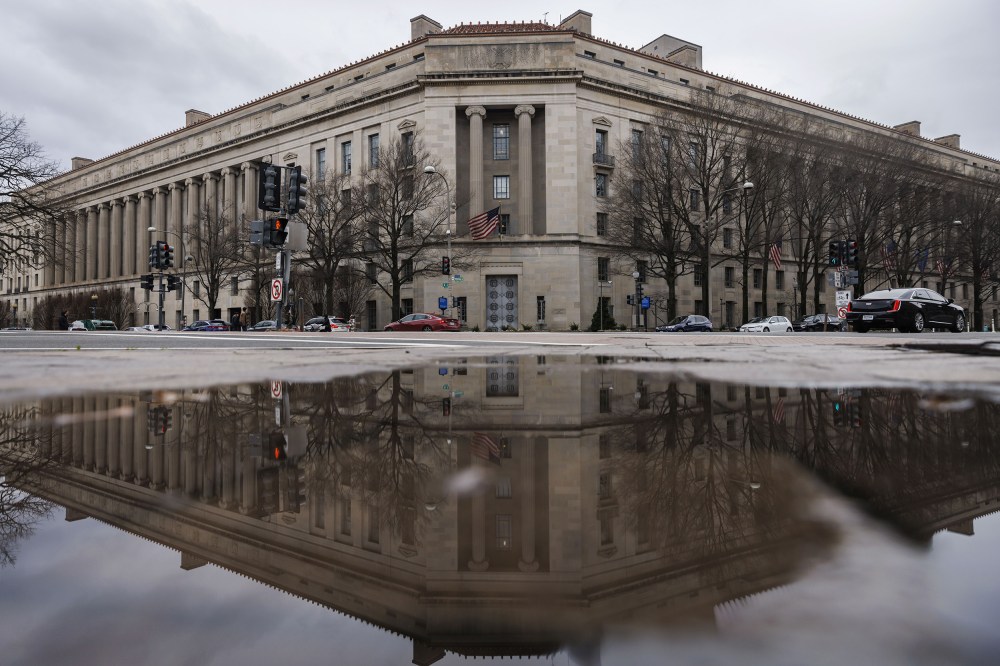
The Department of Justice both embarrassed and exposed itself this week in its handling of the appeals of federal court orders striking down presidential executive orders against four high-profile law firms.
First, the department embarrassed itself by reversing course and moving Tuesday morning to withdraw motions it had filed Monday evening to dismiss its appeals. Four different judges had held that the executive orders violated the First Amendment because they retaliated against the law firms for representing people and causes President Donald Trump dislikes.
Second, the department exposed itself as a purely political actor because every lawyer in the department knows that the federal court rulings were correct and that the executive orders are indefensible.
The department exposed itself as a purely political actor because every lawyer in the department knows that the federal court rulings were correct and that the executive orders are indefensible.
The administration’s efforts and the resulting judicial orders are worthy of careful review. The president began blacklisting law firms last March — using executive orders to, among other things, direct federal departments and agencies to prevent the firms’ lawyers from entering federal government buildings and engaging with federal employees; to revoke their lawyers’ security clearances; and to cancel contracts with companies that do business with the firms. Four law firms subject to the orders filed suit.
Four judges appointed by Republican and Democratic presidents swiftly issued temporary restraining orders barring the provisions that made it nearly impossible for the firms to continue to represent clients that had business with the federal government, threatening their very existence. Two of those emergency orders were issued within hours of the law firms seeking them; the other two within a day. The cases all proceeded quickly to final judgment with the same result: All judges concluded that the orders violated the First Amendment rights of the law firms.
(Shamefully, other law firms that wanted to avoid being blacklisted entered into agreements with the administration to provide hundreds of millions of dollars’ worth of pro bono work to causes favored by the president, raising ethical issues for the lawyers at those firms and the appearance of pay-to-play.)

The judges who ruled in the law firms’ favor didn’t mince words. Judge John Bates, a George W. Bush appointee, wrote, quoting a recent Supreme Court case: “[R]etaliating against firms for the views embodied in their legal work — and thereby seeking to muzzle them going forward — violates the First Amendment’s central command that government may not ‘use the power of the State to punish or suppress disfavored expression.’” He also warned, “More subtle but perhaps more pernicious is the message the order sends to the lawyers whose unalloyed advocacy protects against governmental viewpoint becoming government-imposed orthodoxy. This order, like the others, seeks to chill legal representation the administration doesn’t like, thereby insulating the Executive Branch from the judicial check fundamental to the separation of powers.”
Judge Beryl Howell, a Barack Obama appointee, put it even more succinctly, borrowing from Shakespeare: “In a cringe-worthy twist on the theatrical phrase ‘Let’s kill all the lawyers,’” the executive order “takes the approach of ‘Let’s kill the lawyers I don’t like,’ sending the clear message: lawyers must stick to the party line, or else.”
Judges, like all lawyers, know why this is so important. As Judge Richard Leon, a George W. Bush appointee, put it, “The cornerstone of the American system of justice is an independent judiciary and an independent bar willing to tackle unpopular cases, however daunting.” Without lawyers to advocate for people and causes a president disfavors, even obviously unlawful executive actions could go unchallenged.


With the court decisions stacked so overwhelmingly against the government, one could wonder why the department appealed the lower court rulings in the first place.
With the court decisions stacked so overwhelmingly against the government, one could wonder why the department appealed the lower court rulings in the first place. But it isn’t unusual for the Department of Justice to file a notice of appeal of an adverse ruling even while it is still considering whether to go forward. Decisions like these, at least when I was in the department, were not made by line-level attorneys. The decision to appeal, especially in high-profile cases, would be made by the solicitor general. Today that’s John Sauer, a former personal attorney to President Trump.
Sauer is a seasoned advocate. He famously won Trump v. United States, the 2024 case in which the Supreme Court gave Trump immunity from criminal prosecution for exercising “core constitutional powers” — including directing the Department of Justice to launch “sham” investigations into election fraud — and at least “presumptive” immunity for other official acts.
Whoever made the decision to dismiss the appeals, you can bet that in this administration it would have been considered at the highest levels. That means it likely would have been blessed by Deputy Attorney General Todd Blanche — another former personal attorney to Trump — and Attorney General Pam Bondi, who represented Trump in his first impeachment trial. Although the Justice Department has, under their leadership, become a tool for enforcing the president’s political whims, Blanche, Bondi and Sauer are all experienced enough to know that appealing the district court decisions was a sure loser.
Until the recent tariff decision, the Trump administration has had a winning record at the Supreme Court, and Justice Department leadership presumably preferred to keep it that way. With no hope of winning in the D.C. Circuit — which would have been the next stop for the four cases — and no reason to want to seek review in the Supreme Court and risk losing there, the smart move was to cut their losses and dismiss the appeals. Another reason to think department leadership recognized this: They had already made the decision last spring not to ask the Supreme Court to stay the district courts’ temporary injunctions, something they have done in so many other cases.
They knew then, as we all know now, that the blacklisting orders were textbook First Amendment retaliation.
So what happened to cause this legal about-face? Was it the headlines calling out the decision to dismiss the appeal? A call from the president or fear of a call from the president? Whatever the specific motivation, there is no reason to think that Justice Department leadership saw the legal merits of the cases change overnight. Instead, the department has embarrassed and exposed itself yet again.

Mary McCord
Mary B. McCord is an MS Now legal and national security contributor, and co-host of the MS Now podcast "Main Justice." She is executive director of Georgetown Law's Institute for Constitutional Advocacy and Protection. She previously served as the acting assistant attorney general for national security at the Department of Justice and was an assistant U.S. attorney in the District of Columbia for nearly 20 years.