








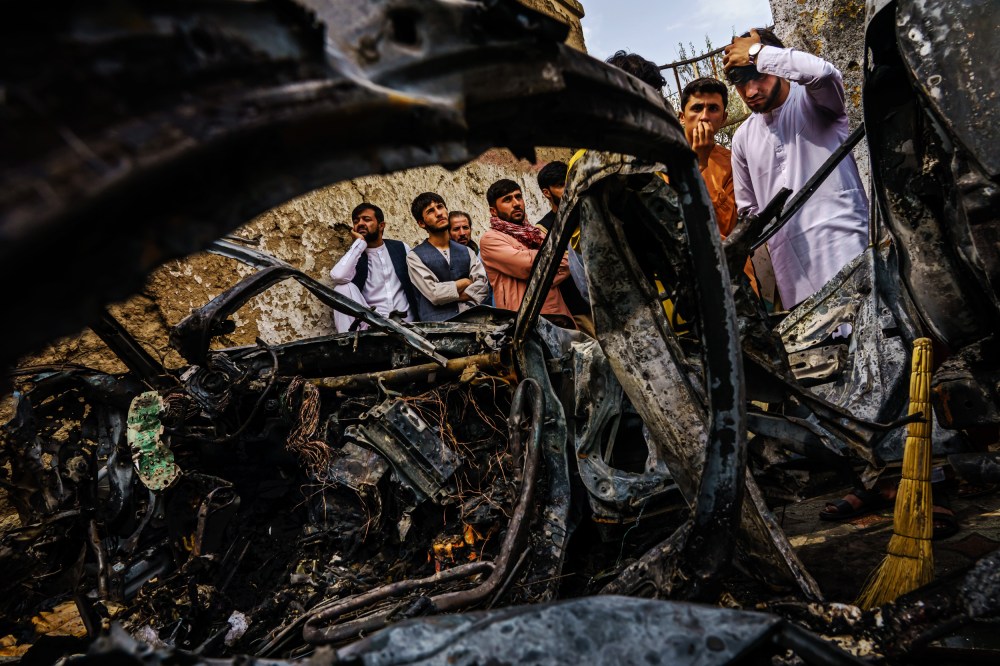
The Pentagon on Wednesday announced that an internal report cleared those responsible for the drone airstrike in Kabul, Afghanistan, that killed 10 Afghan civilians, including seven children, in August, finding “no violation of law, including the Law of War” and recommending no sanctions against those involved in the deadly error.
The U.S. military is telling America, and the world, that deaths of innocent children are “regrettable” but ultimately “understandable” given the way we now conduct war.
Unfortunately, this “carefully” done review is a black box. We don’t get to see any of it.
What we do get to see — a one-page, public-relations-jargon-filled fact sheet — is itself damning, though. The U.S. military is telling America, and the world, that deaths of innocent children are “regrettable” but ultimately “understandable” given the way we now conduct war.
It is a horrifying wake-up call that comes as no surprise to those who have followed the advent and expansion of drone warfare. But, as with all recurring horrors, there are moments that prompt more attention than others — and sometimes even change.
Aimed at clarifying to the media and public the findings of the internal review of the Aug. 29 drone strike, the fact sheet released along with a briefing Wednesday instead served primarily to highlight the problems with this week’s report, the problems with the initial review of the strike and the unconscionable problems with the drone strike itself.

While The Associated Press described the review as “independent,” the review was done by the Air Force’s inspector general. The Air Force inspector general is independent from those involved, but not independent in the way that most would take the word “independent” to mean: an entity outside of the U.S. military. And although the Pentagon released the one-page fact sheet about the internal investigation, it did not release the report or any part of it — even in any redacted form. Instead, the fact sheet said the entirety of the report is classified “because the required detailed analysis included highly classified information.”
What we do learn is that the investigation found nothing illegal about the deadly error and did not recommend any sanctions against those involved.
According to the fact sheet, the investigation concluded that the intelligence assessment was “regrettably inaccurate,” prompting the “regrettable strike,” leading to “regrettable civilian casualties.” The authorization of the strike was nonetheless “understandable,” the fact sheet stated, despite the inspector general concluding both that “the vehicle, its occupant and contents did not pose any risk to US forces” and that “the assessment, prior to strike, of individuals in the target area was inaccurate.”
The intelligence assessment was “regrettably inaccurate,” prompting the “regrettable strike,” leading to “regrettable civilian casualties.”
The Pentagon announced instead that “confirmation bias” led to the continued assessment that the car that was the subject of the strike posed an “imminent threat” and that “footage showed at least one child present two minutes before the strike was launched.”
Despite all of this, as the AP reported, the Pentagon concluded the strike on innocents “was not caused by misconduct or negligence, and it doesn’t recommend any disciplinary action.”
This is more damning than a review finding negligence or misconduct would have been because it tells us that, despite the many mistakes listed as having been made in the lead-up to the strike, the Pentagon has concluded that those involved exercised a reasonable amount of care in their actions.


The perceived speed with which the military needed to act given the concerns about another attack on the U.S. mission at the airport in Kabul and the information available at the time meant that the deaths were regrettable — but not negligently so — the inspector general concluded.

These reasons — basically, limited information and the need for quick action — are almost always going to be present when a drone strike, such as the one launched Aug. 29, is being considered. Given the lack of consequences for that one, then, a deadly repeat is all but inevitable.
The immediate review after the deadly strike — which led to the military initially defending the “righteous strike” — also was flawed, the fact sheet detailed.
The initial review “failed to accurately assess” what happened, leading to “inaccurate public messaging.” Nonetheless, these falsehoods were OK, the fact sheet implied, because they resulted from information that was “genuinely believed” to be true at the time.
Finally, in its recommendations to “refine” the drone-strike process, the review implicitly made clear that, going forward, it does not expect an end to such deaths.
The fact sheet is a public relations document. It is focused on language about how the strike was “regrettable” and how mistakes related to it were “genuine,” while clearing those involved of any responsibility. The Pentagon has to do this as long as such weapons are in use because these modern weapons allow for — or even encourage — such deadly errors.
The Pentagon’s fact sheet all but said these sorts of civilian deaths are an inevitable part of drone warfare.
Regrettably.

Chris Geidner
Chris Geidner is a journalist and MSNBC columnist whose Law Dork newsletter covers the Supreme Court, law and politics. His more than two decades in journalism include widely recognized coverage of LGBTQ issues, the criminal legal system and other complex legal and political questions. Geidner also contributes to Grid and Bolts and previously worked as the Supreme Court correspondent and legal editor at BuzzFeed News, as well as for The Appeal and Metro Weekly.