








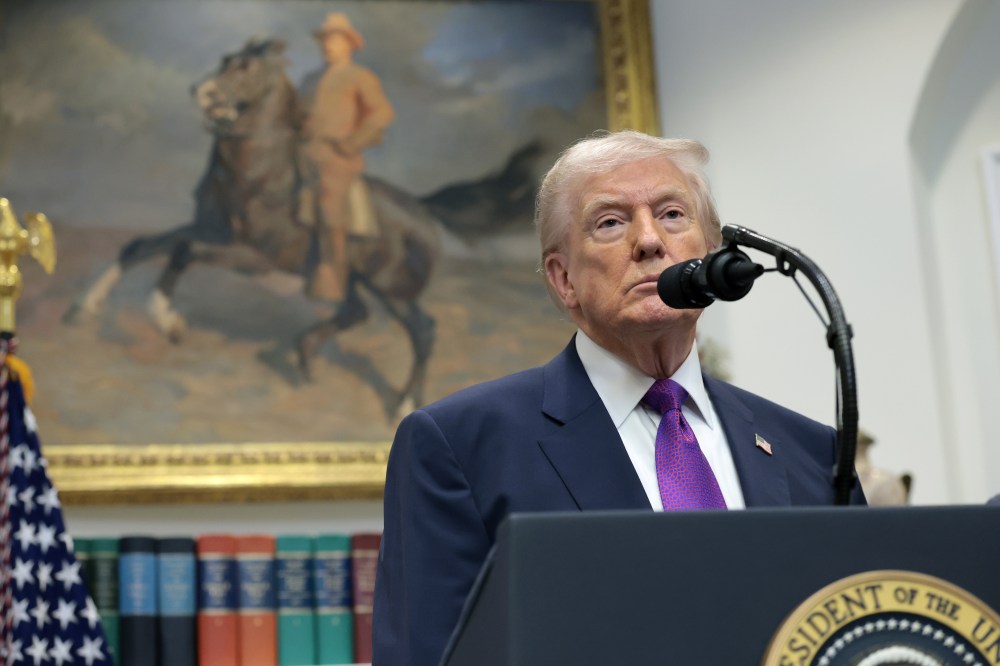
President Donald Trump on Thursday announced the EPA is revoking the endangerment finding, the government’s legal authority to regulate greenhouse gas emissions in place since 2009.
The finding acknowledges that greenhouse gas emissions are harmful to public health, which has been the consensus among the vast majority of climate scientists for decades.
“It has nothing to do with public health,” Trump said Thursday from the Roosevelt Room. “This was all a scam, a giant scam. This was a rip-off of the country by Obama and Biden.”
The initial proposal of the repeal – which appeared in the Federal Register last summer – cited a prior draft report from the Climate Working Group, a consortium of five scientists tapped by the Department of Energy to examine the relevant science. The proposal said the draft report was “reviewed and relied upon in formulating this proposal,” mentioning it more than a dozen times.
Since the proposal’s release, the Trump administration has seemingly tried to distance itself from the CWG, ultimately not crediting CWG in the final ruling. This is an apparent attempt to pivot away from arguing the science to making an argument about the authority of the regulations.
Indeed, the EPA told MS NOW in an email that it did not rely on the CWG report, draft or otherwise, as a basis for its final action to rescind the 2009 Endangerment Finding.
But MS NOW has reviewed documents revealed as a result of an earlier lawsuit filed last August by the Environmental Defense Fund and the Union of Concerned Scientists, giving us an inside look at the making of the CWG report. The documents demonstrate why the Trump administration may have wanted to put daylight between itself and the group’s report.
“They wrote a very slanted report in private,” Fred Krupp, the president of the Environmental Defense Fund, told MS NOW. “And that document that those five handpicked people wrote, you know, is the justification for this. It is not the least bit credible or scientific.”
In an internal review of the CWG’s work, which was released after the EDF lawsuit, DOE personnel describe aspects of the report as “misleading,” “inaccurate,” “not true,” and “cherry picked.”
After EPA Administrator Lee Zeldin initially proposed revoking the endangerment finding, the National Academies of Sciences, Engineering and Medicine re-evaluated the policy, saying the science “has stood the test of time,” and is “now reinforced by even stronger science.”
But one member of the working group wrote in an email months before the re-evaluation was published, “Without even reading the NASEM report I assume it’s useless,” later saying that the NASEM “deserve the DOGE treatment.”
In another email, a team member wrote that lawyers involved in the case “believe they can win this fight without the science,” but said that “if the science argument is decided upon by a vote, or by the number of published citations, we lose the science argument.”
“This repeal is unlawful. The Supreme Court decided years ago that of course climate pollution endangers people and human lives,” Krupp said, previewing the EDF’s upcoming legal challenge to the EPA’s rescission. “We have a very strong case, and we will see them in court.”
The Department Energy has not responded to MS NOW’s request for comment on the Climate Working Group. In a 2026 statement to The New York Times, a spokesperson for Energy Secretary Chris Wright said, “The activists behind this case have long misrepresented not just the actual state of climate science, but also the so-called scientific consensus.”

Nick McCool is an overnight reporter for MS NOW.
Kate Holland is a segment reporter for MS NOW