







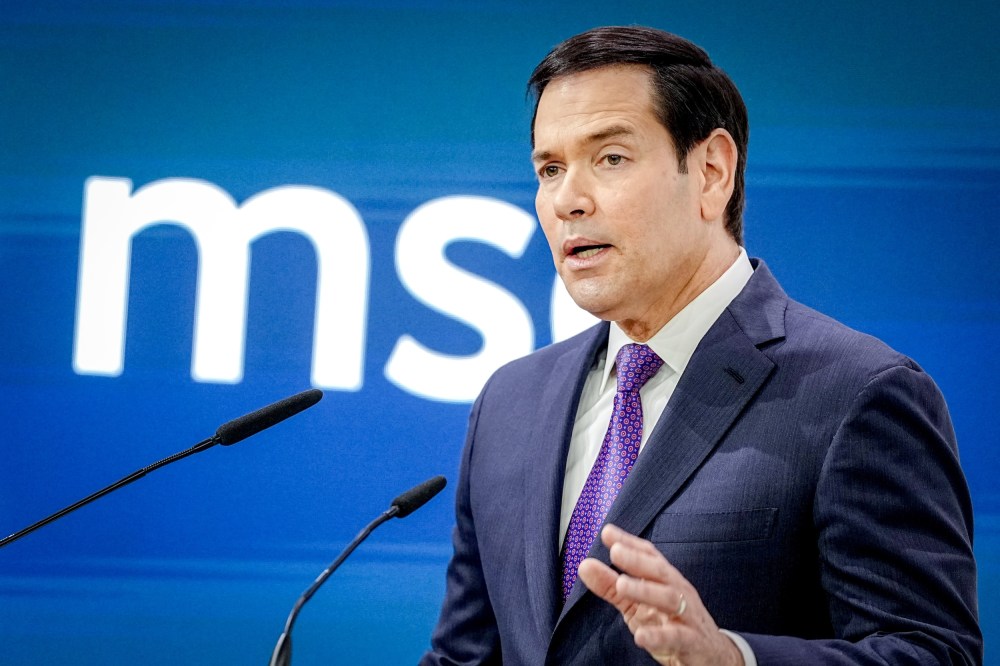
MUNICH — Marco Rubio and Alexandria Ocasio-Cortez delivered dueling visions of how to remake America and the world on Saturday at the Munich Security Conference. And while thousands of miles away from Washington, their arguments could easily have been interpreted as a preview of the 2028 U.S. election.
The secretary of state gave a clear distillation of a MAGA-influenced Republican foreign policy in an address that sparked a standing ovation from Europeans seemingly unnerved by the first year of Donald Trump’s second term — a far cry from the jaw-dropping silence of last year, when Vice President Vance stunned European leaders in Munich with a lecture about ending their isolation of far-right parties.
“We do not need to abandon the system of international cooperation we authored, and we don’t need to dismantle the global institutions of the old order that together we built,” said Rubio, referring to NATO and the United Nations. “But these must be reformed. These must be rebuilt.”
The New York Democratic congresswoman, on the other hand, perhaps fueling speculation about her presidential aspirations, laid out what her party has labeled a “foreign-policy for working class Americans” agenda addressing economic inequality, authoritarianism and A.I.’s rapid rise. Asked at a meeting with a small group of reporters if her plans were too idealistic, Ocasio-Cortez said radical change is needed.

“We have no other choice. The only alternative is a world that is dominated by a handful of elites, a handful of oligarchs that sit on pretend democracies and make backdoor deals with one another,” she said. “And that, to me, is not the world that the vast majority of people in the world want to live in.”
Ocasio-Cortez expanded on remarks she made on the first day of the conference in which she argued that addressing the economic uncertainty of working-class voters would help “stave off the scourges of authoritarianism” globally. She added on Saturday, “Much of this right-wing populist uprising that is built on strength of authoritarianism is based on a material decline of the working class.”
Ocasio-Cortez, who floated a global minimum tax on corporations, said trade agreements should be examined for corporate hand-outs that would be voted down in Congress if they were required to be enacted as laws.
“There are hundreds of pages in our trade agreements that are non-tariff corporate protectionist policies,” she said. “And oftentimes, our trade agreements are used as a back door to pass policies that would never be tolerable in domestic politics, certainly in the United States.”
She added that she wanted to enact policies that ensure that the benefits of innovation and investment will “actually benefit working class Americans and working-class Europeans.” She also called for Americans “to restrain ourselves from the military interventions of our past.”
“I really do believe that we’re in a fork in the road,” she argued. “I believe that leaders are increasingly acknowledging that we must present an alternative vision.”

Rubio’s speech at the security conference here, in its tone and depth, was the opposite of the one Trump delivered when European leaders gathered in Davos, Switzerland, last month. Rubio invited Europe to join the U.S. in reforming international institutions, not destroying them.
“So in a time of headlines heralding the end of the transatlantic era, let it be known and clear to all that this is neither our goal nor our wish,” Rubio said. “Because for us Americans, our home may be in the Western Hemisphere, but we will always be a child of Europe.”
Highlighting the shared civilization between Europe and the United States, Rubio used the phrase “western civilization” as often in his speech as he uttered the word “democracy.”
“It was here in Europe where the ideas that planted the seeds of liberty, that changed the world were born,” he said. “Which gave the world the rule of law, the universities and the scientific revolution, it was this continent that produced the genius of Mozart and Beethoven, of Dante and Shakespeare, of Michelangelo and Da Vinci, of The Beatles and The Rolling Stones.”
Rubio, 54, then hailed the joint U.S.- European effort winning the Cold War. But he argued that after the collapse of the Soviet Union in 1991, U.S. and Europeans policymakers moved too far away from the model of the nation-state.
“But the euphoria of this Triumph led us to a dangerous delusion that we had entered ‘The End of History,’” he said. “That every nation would now be a liberal democracy, that the ties formed by trade and by commerce alone would now replace nationhood, that the rules based global order, an overused term, would now replace the national interest.”
Ocasio, 36, embraced a view of universal freedoms and human rights that extended beyond Europe and the west. She criticized the treatment of Palestinians in Gaza and said that inequality and hypocrisy were radicalizing working-class citizens who feel cheated.
“So, to me, this is not a matter of idealism,” she said. “This is not a dream. This is what we must do to retain the global order.”

David Rohde
David Rohde is the senior national security reporter for MS NOW. Previously he was the senior executive editor for national security and law for NBC News.