





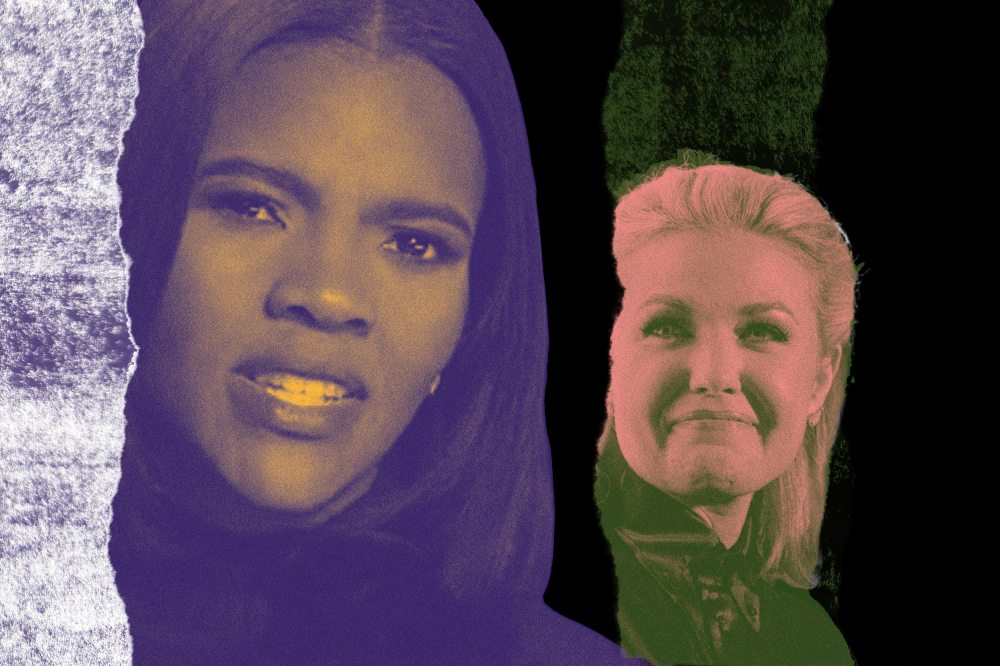
Candace Owens is a conspiracy theorist.
The independent podcaster is not an investigator, but she casts herself as one on her eponymous weekday internet show. Candace — as she is known to her fans, and as I’ll call her — is pretty and contrarian and chaotic and occasionally funny, and she has the coveted influencer quality of authenticity, even as she feeds her audience wild and often baseless accusations each episode. She is the Oprah Winfrey of Alex Joneses.
She is also one of the fastest-growing and most influential voices on the conspiratorial right — a large and expanding segment of conservatives who shape their worldview through social media and podcasts. Candace boasts 6 million followers on Instagram and more than 7 million on X, and she’s creeping toward 6 million subscribers on YouTube, where she operates the 16th most popular channel for news and politics — just below CBS and above the Associated Press, according to social media monitor Social Blade.
I say all of this first to explain why, although she is a deeply unserious person, we must unfortunately take Candace Owens seriously. Because Candace’s brand of conspiracist infotainment and the claims she makes on her daily YouTube show — fevered, bigoted and perhaps defamatory — increasingly threaten to upend not only right-wing politics, but also the broader information landscape.
Lately, Candace’s world-building enterprise has centered on her former employer and friend Charlie Kirk, the founder of Turning Point USA, who was shot and killed at a Utah Valley University event in September. The news of his death made Candace — a former communications director at TPUSA and podcaster at The Daily Wire — the brightest star in a constellation of creators who built massive followings alleging conspiracies around every major event.
Whether one believes the mainstream account of Kirk’s death — that he was murdered by a politically motivated Utah man named Tyler Robinson, as the FBI and state prosecutors allege — or subscribes to a shifting collection of alternative explanations by influencers, the incident has become a kind of litmus test for conservatives, separating the far-right from the far-out.
In the interest of taking Candace Owens seriously, I have watched about 80 hours of her show and archived each transcript since Charlie’s death. In between reading ads for face cream and beef and anti-abortion crisis pregnancy centers, Candace pulls up her conspiracy board and spins a new yarn about who might be implicated next in Charlie’s killing or its cover-up.
Candace spearheaded many of those claims, including vague assertions of Israeli government involvement and unfounded suggestions that Turning Point brass betrayed their founder. But this week, Candace zeroed in on someone who would have been an unthinkable villain in September: Erika Kirk, Charlie’s widow and successor at TPUSA.
On Wednesday, a day after Erika Kirk appeared as a guest of President Donald Trump at the State of the Union address, Candace aired what she billed as a special investigative series on her YouTube channel: “Bride of Charlie.” I joined a quarter million viewers watching her livestream Wednesday.
Wearing a billowy silk blouse, Candace opened her special with ominous violin music.
“Something is not right with Erika Kirk,” she said.
Candace spoke in whispers and scrunched her forehead through her hourlong monologue. She was “bothered” and “troubled” and “struck,” she said, by what she called “wrinkles” in Erika Kirk’s backstory — discrepancies she claimed to have found in high school yearbooks, old Instagram posts, local newspaper clippings and her parents’ divorce records from the 1990s. The hospital where she was born, Candace said, had once experimented on patients’ brains. A day care photo showed toddler Erika Kirk “throwing up Freemason hand signs.” Her great-grandmother was involved somehow in illegal slot machines. Her elementary school was “exceedingly Jewish.” Candace accused Erika Kirk of lying, but didn’t identify a particular lie. She speculated that her mother was not actually her mother.
Candace said she spoke to ex-boyfriends and old classmates for her investigation, gleaning information she said will be revealed in future episodes. But it’s not clear what she was alleging. None of her stories suggested misdeeds — or much of anything at all — by Erika Kirk, let alone a connection to her husband’s demise. But to Candace, it was all deeply suspicious.
The show had been panned by an unlikely chorus: Ben Shapiro, her former boss at The Daily Wire, responded to the trailer by calling Candace “an evil, twisted human being”; Islamophobe Laura Loomer said the campaign against Erika was “depraved”; Sandy Hook truther Alex Jones called it a “witch hunt.”
As Jones knows well, spreading conspiracy theories about real people isn’t without consequences. The subject of Candace’s last big series was a “transvestigation” — hours of already debunked claims alleging that France’s first lady, Brigitte Macron, was born a man and that Emmanuel Macron had been installed as president of France by the CIA. The Macrons sued her for defamation in Delaware last year. Candace called the lawsuit a “desperate public relations strategy,” and the case is pending.
TPUSA could come for Candace next. In a January episode of her show, Candace read aloud from what she said was a legal letter sent from the conservative organization, demanding that she cease “to state or imply that Turning Point USA and/or its employees, agents, directors, officers, affiliates, programs or services played any part in Mr. Kirk’s assassination … knew about the assassination beforehand, participated in the assassination … or covered up the truth about the assassination after the fact.” Candace responded by saying it was “gay.”
You might think that as a grieving widow, Erika Kirk would be embraced by those on the right who had loved her husband. Strangely, though, since September, online mobs and popular influencers from both the right and the left have treated her like the spouse of a missing person — more as a suspect than a victim. Content creators and their audiences have watched her every move: Her wardrobe, her handkerchief, who she hugs and for how long, her makeup, her meetings with TPUSA staff and the placement of photos in her home office are all treated as signs of her complicity.
Complicity in what? It’s difficult to say, because the theories shift weekly. But for conspiracist consumers, a clear narrative matters less than the thrill of the hunt.
In the interest of taking Candace Owens seriously, I have watched (often at 2x speed) about 80 hours of her show and archived each transcript since Charlie’s death. In between reading ads for face cream and beef and anti-abortion crisis pregnancy centers, Candace pulls up her conspiracy board and spins a new yarn about who might be implicated next in Charlie’s killing or its cover-up.
Here, as best as I can construct it from some 70 episodes, is Candace’s evolving theory of the case:
Erika was initially a sympathetic character. Candace described the widow’s memorial speech — in which she forgave alleged assassin Tyler Robinson — “the most consequential speech in American history.”
But within a week of Charlie Kirk’s death, Candace was publishing videos about his attitudes toward Israel and his relationships with Jewish donors — suggesting a link between the two and his killing. They were baseless claims aimed at a familiar target; Candace is well known for antisemitic comments and a general obsession with Jews.
But there was more. Candace suggested that Robinson’s text confession had been fabricated by federal agents, and presented flight logs from Egyptian military planes as evidence that powerful people in the Middle East were following the Kirks. She claimed that Israeli cellphones were detected on the campus where Charlie Kirk had been shot. And French Foreign Legion soldiers had been spotted training with Marines weeks before he died. Then there was the bullet that didn’t exit his body, text messages showing he had distanced himself himself from the pro-Israel cause, and a secret meeting at an Arizona Army base between a guy named Mitch and a woman who looked like Erika Kirk.
Things get a little fuzzy from there — something about dreams and Satan and an X-Men school for the gifted and time travel and Japan and Liberty University. The episodes rarely make sense, but together they paint a baseless picture of Jewish billionaires, a corrupt federal government and a greedy conservative youth organization conspiring to eliminate Charlie Kirk because he had finally broken free of their control.
By the new year, Erika Kirk’s name was on Candace’s conspiracy board.
“Erika Kirk should be dragged into a police precinct for questioning,” Candace said earlier this month.
Fact-checkers have examined the most coherent claims about Erika Kirk and found them wanting. Lead Stories, which uses a proprietary algorithm to identify viral misinformation, reported that there was no evidence to support claims that Erika Kirk was a recruiter for Jeffrey Epstein, or had participated in her husband’s murder, or had helmed a Romanian charity linked to child trafficking.
But facts are no match for Candace Owens. And as with any good conspiracy theorist, it’s not the answers, but the questions that will matter to her audience.
“I promise you we’ll go all year,” Candace said as the first episode wound down. “We’ll just be like, this is a never-ending series.”

Brandy Zadrozny is a senior enterprise reporter for MS NOW. She was a previously a senior enterprise reporter for NBC News, based in New York.