







This is the March 6, 2026, edition of “The Tea, Spilled by Morning Joe” newsletter. Subscribe hereto get it delivered straight to your inbox every Monday through Friday.
BREAKING: UAE cuts off Iran economic lifeline
]The United Arab Emirates acted early today on its threat to freeze billions of dollars in Iranian assets, a government official in the Gulf told me this morning. The UAE has long served as a financial hub for Iran and its business interests seeking to evade Western sanctions.
The Wall Street Journal reported that such a move by UAE officials would sever a key economic lifeline for Iran, cutting off its access to foreign capital and trade.
Iran, which has fired more than 1,000 missiles into the UAE, has suffered a sharp economic downturn that fueled public unrest in the weeks leading up to the American and Israeli strikes on the country.
And on that note, let’s turn to the weekend.
ON THE CALENDAR:
Much of the country is about to get its wish — later sunsets will begin this weekend as the clocks spring forward. Ready to make the most of the extra daylight? Start right here:
In New York City, the Lower East Side hosts the New Colossus Festival, welcoming almost 200 independent artists and musicians from all over the world to the city that never sleeps.
Spring may be around the corner, but you can bid farewell to the last dregs of winter at the Melt on Wall Street in Norwalk, Connecticut. Warm up over a soup crawl, cozy up in heated igloo tents, and toast some s’mores over a firepit.
Prefer to turn up the heat a bit more? Lace up your trainers and run to Columbus, Ohio, where the Arnold Sports Festival draws more than 10,000 athletes from over 80 countries for the nation’s largest multisport gathering. On the docket: 5Ks, bodybuilding, equestrian events, martial arts, dance fitness, and plenty more.
Meanwhile, it’s time to boogie in Nashville, Tennessee, where legendary disco icons KC and the Sunshine Band will bring their “Get Lifted” world tour to the historic Ryman Auditorium.
And down in Miami, Jazz in the Gardens returns for a two-day music fest with Jhene Aiko, Ludacris, and Ella Mai on the lineup.
Now, let’s answer your questions.
MAILBAG
Joe, you stated that you were told that one of the goals of the attack on Iran was to deny China and Russia’s access to cheap oil. What do you think would happen if China and/or Russia decided to send “advisors” to support the Iranians?
— Rick K., Paris, Maine
Rick, we may be about to find out. The Washington Post is reporting this morning that Russia is providing Iranians with intelligence that will help them strike American targets in the air and on the sea, citing three officials familiar with the intelligence.
Vladimir Putin’s decision to work in concert with Iranians to kill American soldiers comes the same week that President Donald Trump insulted Ukraine’s Volodymyr Zelenskyy and offered the Russians sanctions relief.
With the war effort going as badly as it is on the Ukrainian front lines, Russia’s move seems extraordinarily shortsighted. And I must say that Trump‘s continued efforts to insult our Ukrainian allies is all the more perplexing.
It builds on the continuing, decades-long question of what Putin has on the American president. Perhaps it’s nothing. But Trump’s continued obsequiousness to a dictator who invades countries, kidnaps children, and now reportedly targets American troops makes no sense to anyone but Donald Trump and Vladimir Putin.
So the U.S. now has air superiority over Iran. The U.S. had air superiority over Afghanistan from Day 1 and where did that get us? What will be different in Iran?
— Charlie Card, Urbandale, Iowa
Charlie, that is the most important question, and it will remain unanswered for some time.
We should salute our men and women in uniform for the extraordinary dedication they have shown in carrying out their military duties. Every observer I have spoken with this past week has called American operations against Iran successful beyond all expectations.
The same could have been said of the invasion of Iraq in March 2003. After George W. Bush unfurled his “Mission Accomplished” banner as a triumphal backdrop to his “victory” speech, the enemy then had its say — as enemies always do.
Seven years later, Americans left Iraq in the dead of night.
The same events — as you point out — played out in Afghanistan after 20 years of battle. Our military involvement in Libya also ended in chaos.
Why will Iran be different? I have no good answer, even as one who is preternaturally optimistic. It is a country that, unlike Iraq or Afghanistan, built deeply rooted institutions within its terrorist state across 47 years.
While the first phase of military operations appears to be going as well as initial U.S. efforts in Iraq, what comes next is anybody’s guess.
And anyone who tells you they know how this ends is lying.
Why doesn’t a reporter ask the president and SecDef the questions that Gen. Colin Powell said we must have answered before getting involved in a military conflict (the “Powell-Weinberger Doctrine”)?
— Anonymous
Pete Hegseth has kicked almost all legitimate reporters out of the Pentagon press pool. So that is one reason any media events there more often than not turn into an echo chamber of praise for government officials.
But to your point, any future military operation’s success depends on answering the questions posed by the Weinberger–Powell doctrine.
Taking from the lessons of the Vietnam War, Caspar Weinberger and Powell said the United States should never commit forces to a conflict unless (1) vital American interests were at stake; (2) American political leaders had a commitment to win; (3) political and military objectives would be clearly defined before the war; (4) the military operation had reasonable support in both Congress and among the American people; and (5) military force would be used as a last resort after all diplomatic efforts were exhausted.
When he was chairman of the Joint Chiefs of Staff during the first Gulf War in 1990-91, Powell refined the Weinberger Doctrine, determining that wars should be fought with decisive force after a clear exit strategy was stated.
You can look at the requirements set out by Weinberger and Powell and realize that many of those conditions, born out of the tragedies of Vietnam, were not met before the Iran attacks began.
ONE MORE SHOT
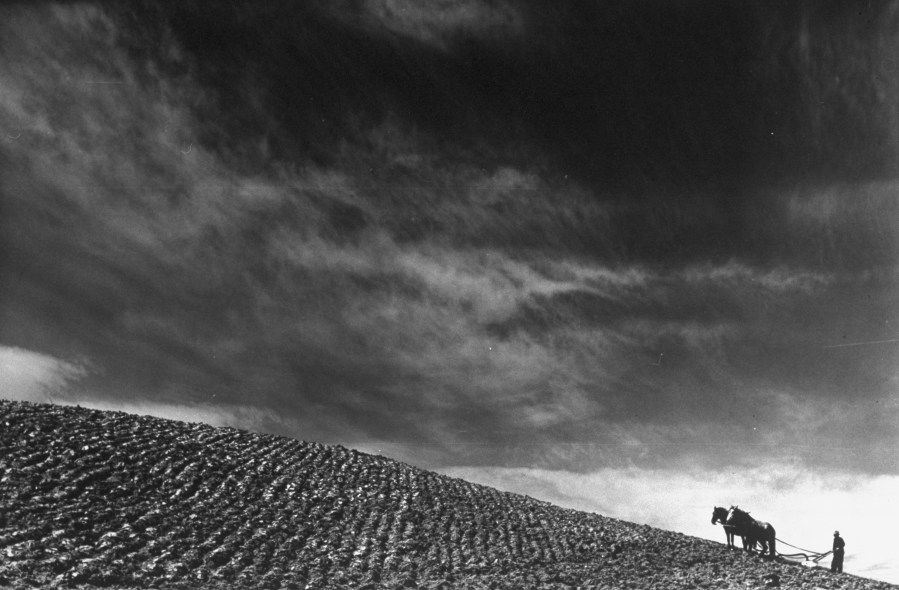
A sharecropper plowing a field with a pair of horses against a threatening sky. This 1937 photo by Margaret Bourke-White is part of Getty Images’ salute to trailblazing women photojournalists.
CATCH UP ON MORNING JOE