








MINNEAPOLIS — On Jan. 22, the Twin Cities woke up to noise.
Protests echoed throughout Minneapolis and St. Paul, and sirens cut through the cold air as thousands of Department of Homeland Security agents fanned out across Hennepin and Ramsey counties, in what department officials called Operation Metro Surge — a sweeping immigration enforcement action that began in December, stretching each day from early morning into the night.
But inside a small home near Powderhorn Park, the city felt quiet. The only sound came from 2-year-old Chloe Tipan Villacis, whispering to her father that she was hungry and wanted fruit.
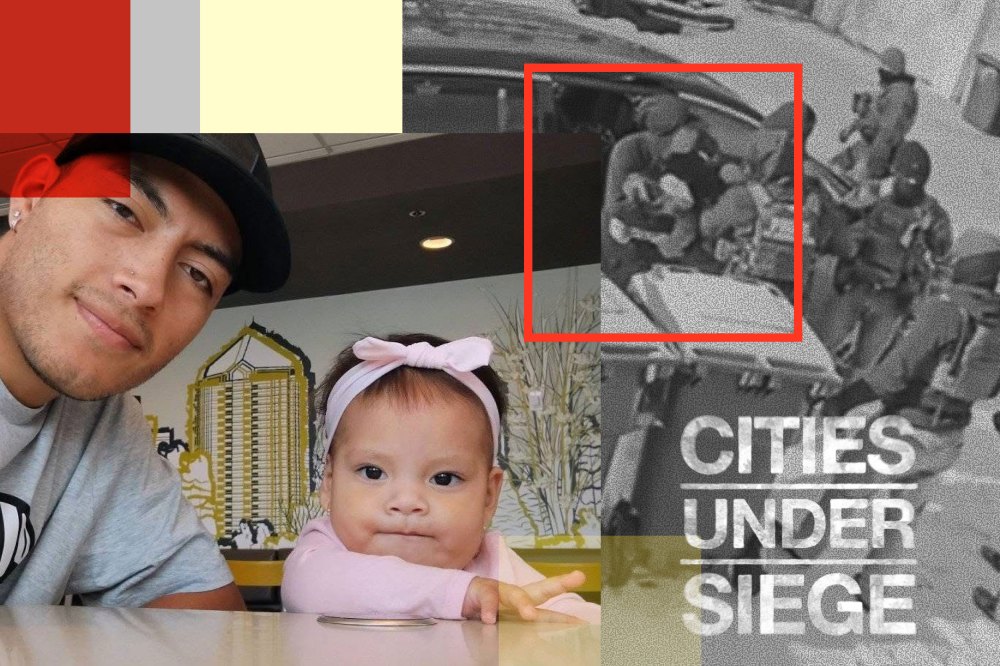
Her father, Elvis Tipan-Echeverría, an undocumented migrant from Ecuador who entered the U.S. in May 2024, lifted his daughter into his red sedan and drove to a nearby store. It was an ordinary errand, but on the way back home, he says he began to feel uneasy. A vehicle appeared to be following him. When he turned onto his street, he saw federal agents gathering near his house.
Tipan says he immediately identified them as immigration officers, so he did not stop. Instead, he drove for several more minutes and started a video call with his wife, Nicole Villacis. He told her he would come in through the back of the house because he believed agents were watching him. He asked her to be ready to take Chloe.
“I was taking a shower and I ran out just like that, with whatever I was wearing, to get my daughter, but it was too late,” Villacis told MS NOW. “When I tried to open the door, the agents were already there.”
Still connected by video, Villacis says she heard the moment her family was ripped apart.
Agents rushed her husband. She watched through a window as Tipan, still in his car, wrapped his arms around Chloe and held her tightly.
“I wanted to go out and grab my daughter,” Villacis said. “But my husband told me to stay inside, he told me that they would take me too.”
Fear pinned her in place.
Tipan, reluctant to open his car door or roll down the window as the agents demanded, begged his wife to call for help.
“I told her to call the police or to ask someone who is American to come get my daughter,” he later told MS NOW from the Sherburne County jail.
Within minutes, he said, agents shattered the car window.
“I hugged my baby and just tried to calm her,” he said. “She was scared. She kept saying ‘mommy, mommy.’ When they broke the glass, she started crying.”
Security video of the incident, obtained exclusively by MS NOW, shows at least six agents, most wearing green vests and masks, escorting Tipan to a dark van as he clutched his daughter. Tipan can be heard repeating to the agents that he wants to keep holding his baby — afraid, he later explained, that they would take her away from him.
Respondents have taken a 2-year-old into custody — an escalation of violence that is unspeakable, cruel, and without any legal basis or justification.”
KIRA KELLEY, ATTORNEY
Chloe was never fully separated from her parents. But the 2-year-old was detained by the federal government, held at an immigration processing facility and then rushed with her father to a commercial flight bound for Texas, as attorneys scrambled to locate them and secure their release. Chloe’s story highlights a concerning trend amid Trump’s aggressive immigration crackdown: Children are being swept up and detained during immigration raids at an alarming rate.
Recent independent analysis by The Marshall Project shows that the number of children held by Immigration and Customs Enforcement has skyrocketed in Trump’s second term — from an average of about 25 children detained per day during the final 16 months of Biden’s presidency to about 170 children per day under Trump. On some days, the analysis found, “ICE held 400 children or more.”
A toddler endures federal custody
Chloe’s traumatic 27 hours in federal custody began with shattered glass.
When agents smashed Tipan’s window, he says that tiny shards scattered across the seat and landed on his daughter’s hand. “She was bleeding a little,” he said, and claimed that no one offered medical care during their detention. Asked about the allegation, DHS Assistant Secretary for Public Affairs Tricia McLaughlin suggested the agency would look into it, but “I highly doubt she was not given care.”
As DHS tells it, Tipan’s arrest was a targeted enforcement operation. U.S. Border Patrol officers identified him as “an illegal immigrant from Ecuador who committed felony reentry,” a spokesperson said. The agency also alleged that he was “driving erratically with a child in the vehicle.”
Tipan denies both claims.
He says he entered the U.S. only once and was driving properly on the day of the incident, without speeding. MS NOW could not locate any criminal history about him beyond court proceedings initiated after his detention.
DHS also claimed that agents tried to give Chloe to her mother and that she refused. Villacis disputes that account. About an hour after the arrest, she said her husband called from a detention center with a message that stunned her.
“They told him to tell me to turn myself in,” she said. “Not to come get my daughter. To turn myself in.”
The call likely came from the Bishop Henry Whipple Federal Building near the Minneapolis-St. Paul Airport, where Tipan and his daughter were initially taken and where most immigrants arrested during Operation Metro Surge are being processed.
That same day, Tipan’s attorneys filed an emergency motion, arguing that both father and daughter were asylum seekers detained without a judicial warrant or final removal order, and that the detention of a 2-year-old was unlawful.
“Respondents have taken a 2-year-old into custody — an escalation of violence that is unspeakable, cruel, and without any legal basis or justification,” wrote attorney Kira Kelley. U.S. District Judge Katherine Menendez granted the motion and ordered the child’s immediate release, but roughly 20 minutes later, lawyers learned that father and daughter were already on a commercial flight to Texas. “They made me travel to Texas with my baby,” Tipan said. “We arrived around midnight. They made us sleep in the airport until morning.”
He said they never left the terminal and that his daughter slept on airport chairs and ate cookies and drank water purchased by custodial officers. “She missed her mom so much,” he said. “She kept saying, ‘mommy, mommy.’” The next morning, they were flown back to Minnesota, as ordered by the judge. Chloe was released to the family’s attorney and then reunited with her mother. Tipan remains in custody.
“She asks for her dad every day,” Villacis said. “I show her pictures of him, so she doesn’t forget his face.”
“The lack of humanity at every step of this process is truly unimaginable,” said Irina Vaynerman, a civil rights attorney and the CEO of Groundwork Legal. “When the government defies court orders and treats families as disposable, it inflicts lasting harm and undermines the foundation of our democracy. What happened to this family is part of a broader pattern in which the federal government unlawfully detains people — including toddlers and children — and rushes them out of state to intentionally evade court oversight.”
“We don’t use children as leverage.”
Tricia McLaughlin, Dhs Assistant Secretary for Public Affairs
Today, Chloe’s parents still find her detention hard to process. Villacis remembers being afraid that stepping outside would come at the cost of her freedom, and perhaps a longer separation from her child.
“If they take me, I won’t see my child for a very long time,” Villacis said of her mindset at the time. “It was a trap,” added Tipan. The family has since decided to return to Ecuador, unwilling to risk their daughter ever being held in detention again. Tipan told MS NOW he has already signed his self-deportation order.
A new era of child detention
According to the Marshall Project, the number of children held in ICE detention on any given day has surged dramatically in the Trump era, “jumping more than sixfold since the start of the second Trump administration.”
Asked about the number of children in DHS custody, and whether this reflects an increased focus on family units or unaccompanied children, McLaughlin said the agency is “working on this to get you information.” DHS didn’t provide further details by press time.
“[Trump] created this connection between immigrants and crime,” said Anna Flagg, senior data reporter for the Marshall Project and co-author of the analysis. “We know children are innocent. Trump’s most loyal supporters would probably agree that putting children in jail is not going to help reduce crime in this country.”
Flagg’s research suggests that the decision to keep children in detention may be driven by pressure to meet deportation quotas.
“If you’re really trying to deport as many people as possible, and you’re bringing families and children into detention — and keeping them in detention — that can be a way of speeding along deportations,” Flagg added. “When people are in detention, they have much less power to fight their case. They have less resources — or just even the ability to communicate with their lawyers.”
But for the journalists behind this analysis, the most alarming aspect about it isn’t just what the numbers show — it’s what they don’t.
“A lot of the oversight mechanisms have been pulled back since Trump took office,” added co-author Shannon Heffernan, staff writer for the Marshall Project. “Our ability to see inside and actually understand what’s happening is very limited. And the information that does come out of those facilities often comes at great risk to the families who are worried about retaliation in their cases.”
DHS is facing new scrutiny over its treatment of children, in part because of the aggressive tactics its agents employ during operations — some of which made national headlines in recent weeks.
‘We don’t use children as leverage’
Amid the chaos of his arrest, Tipan says agents pressured him to give Chloe up and urged him to persuade her mother to come outside.
“One agent told me to call [my wife] so she could come get [our daughter],” he said. “Another agent, he was Mexican, told me to hand over my daughter. I didn’t trust them.”
He told MS NOW he also believes agents deliberately used his daughter to lure his wife out of the home. Asked about the allegation, McLaughlin said that “we don’t use children as leverage. We enforce the law that was passed by Congress.”
Their story is reminiscent of another case that occurred just 48 hours earlier, in nearby Columbia Heights, Minnesota, when an image of a child in a blue hat and a Spider-Man backpack went viral. The child was 5-year-old Liam Conejo Ramos, detained by federal immigration officers alongside his father as they returned home from Liam’s preschool. It was a highly controversial operation in which, according to school officials, federal agents told young Ramos to knock on the front door of his house to get others to open it, essentially using the child as bait.
Like Chloe, Liam was quickly put on a flight bound for a detention center in Texas. And like Chloe’s mother, Liam’s mother, Erika Ramos, remained inside her home, frozen by fear.
“I witnessed the scene from the window, unable to do anything,” Ramos told Telemundo in Spanish. “[My husband] begged me over and over not to go outside. He was afraid they would detain me too.”
Liam was in ICE detention for almost two weeks at the Dilley Immigration Processing Center in Texas, until a judge ordered his immediate release on Sunday. “It should not take a court order to get a toddler out of a prison,” Minnesota Gov. Tim Walz wrote on X after the ruling.
The Dilley center is a highly regulated ICE facility and the nation’s primary family detention center. It’s where Chloe and her dad were likely headed before a judge ordered them back to Minnesota. During a recent visit following Liam’s detention, U.S. Rep. Joaquin Castro, a Democrat from San Antonio, reported seeing parents and children among the more than 1,000 detainees housed there, including a 2-month-old baby.
“You see parents trying to be strong for their kids,” said Castro. “But this system has broken a lot of folks. … They are literally being treated as prisoners. This is a monstrous machine.”
That machine did not stop at arresting adults. It reached into car seats and preschool routines and left mothers listening from inside, unable to move, as their children cried outside.
“My baby cried a lot,” said Villacis. “I had to watch how they took my baby away. No mother should ever live through that.”

Kay Guerrero
Kay Guerrero is a senior producer of newsgathering for MS NOW.

Jacob Soboroff is a senior political and national correspondent for MS NOW.