




I’ve heard a lot of coming out stories over the years. It’s the one story I can confidently say we all tell, without fail, on any first date with another queer person.
I’ve been on dates where people recounted being kicked out of their homes by families who they still don’t talk to. I’ve met people who’ve been subjected to conversion therapy after coming out. While my own story isn’t as traumatic as theirs, my own anxieties about not knowing if people will love me or not carry through from then until now.
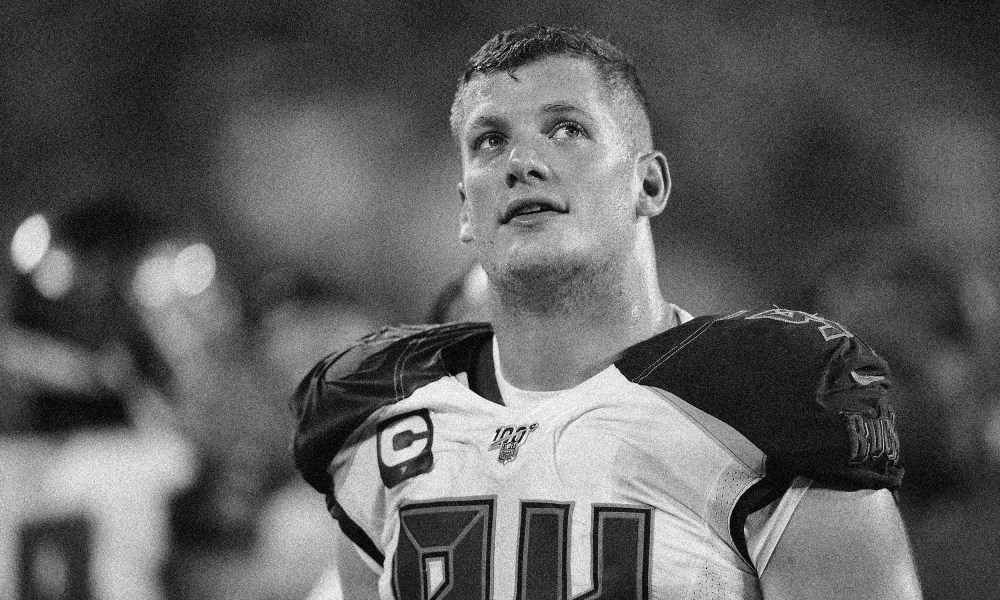
But I’ve never had anyone tell me a story like Carl Nassib’s coming out story. Nassib, a defensive end with the Las Vegas Raiders, logged onto Instagram and with a few short words changed history: “What’s up, people. … Just want to take a quick moment to say that I’m gay.”
With that casual, almost anticlimactic statement, Nassib broke a glass ceiling that’s hung heavy over men’s professional sports for years.
At a time when we’re seeing LGBTQ people both in and out of the public eye coming out at historic rates, Nassib’s decision is the most seismic so far this year. It forces a conversation about queer inclusion and acceptance in a part of the American pop culture space that continuously struggles to have one. But thinking back on all the times where our hopes have been raised only to be disappointed, I hope Nassib’s story is different — and that we aren’t placing too much on his broad shoulders in the process.
There has been a trickle of major league players who’ve come out of the closet after retiring from their respective games in the last decade, with 28 in the NFL alone. But it’s been slow progress compared to other cultural touchstones like Hollywood’s film industry or music or even the staid world of politics. So we have yet to see an openly queer person actually play a full season in any of the four major U.S. sports leagues — the NFL, MLB, NBA and NHL.

There have been some who came close, each history-making in their own ways but not quite ending the stigma that permeates America’s sports culture. When basketball player Jason Collins came out toward the end of his career in 2013, he became the first male major league athlete to play professionally while being openly gay. His coming out on the cover of Sports Illustrated was, and continues to be, iconic — but it didn’t last very long. After a lengthy free agency, Collins signed a 10-day contract with the Brooklyn Nets in March 2014, followed by two renewals. He retired in 2014 after playing in 22 games with the Nets while out, less than half the season full season. The conversation about being LGBTQ in the NBA calmed down pretty quickly.
The next year, college football star Michael Sam came out before being drafted in the NFL. The moment was met with even more excitement. Sam was just beginning his career, having just won defensive player of the year in college football’s hypercompetitive Southeastern Conference. The hope was that he’d enter the season as both a budding star and an openly gay man — maybe even with his partner by his side — becoming a symbol of how far we’ve come.
It would be another five long years before former Tampa Bay Buccaneer Ryan Russell came out as bisexual in an ESPN essay. Since then, he’s become the most visible athlete in the NFL fighting to create change alongside retired athletes like Wade Davis Jr., who consults for the NFL. Like Nassib, Russell had played in the NFL already while in the closet. But as a current free agent, he’s at the mercy of the league’s franchises to give him a chance to play again. Russell is still looking for a team to recruit him 22 months after his essay was published.
During our celebrations of Nassib, we have to acknowledge how long he had to sit with this secret — an agonizing 15 years. We can’t forget the culture of silence from a majority of NFL players as they attempt to pretend that there haven’t been gay men playing next to them during their careers. This unspoken denial has stayed consistent as these few players — a majority of them Black queer men — try again and again to normalize their place in the major leagues. Because even with Nassib, while we have seen a few players on the Raiders and the NFL more broadly tweet out support, most players will likely still refuse to even acknowledge these men. When they finally do, that’s when we can expect even bigger change than what Nassib is ushering in now.


During our celebrations of Nassib, we have to acknowledge how long he had to sit with this secret — an agonizing 15 years.
It should be strikingly clear that we as queer people exist in every aspect of society — we always have. And when we look back, the lack of LGBTQ representation doesn’t mean we weren’t there. We should see a history of players feeling forced to suppress their full selves on and off the field.
Hall of Fame NBA player Dennis Rodman, who has identified as bisexual a few times (but always said he’s never been with a man), once said in an interview that he thinks 10 to 20 percent of the players in the NBA and other professional sports are queer. Russell, who I recently interviewed for a project not yet out, also agreed with Rodman that a sizable percentage of the NFL is not totally straight. And I’ve heard variations of this from retired athletes I’ve met over the years who all know a closeted player from their time on the field.

This all makes Nassib coming out as a mid-career player who, as of now, will be playing this fall a very big deal. There’s an inherent risk that comes with being a “first” or an “only” in any field — the pressure is on for Nassib to represent the full LGBTQ community in the coming season. His performance as his full self on national television every Sunday will be a lens for critics to judge the future performance of any openly gay or bisexual players who could be waiting on the sidelines. It also remains to be seen whether the treatment that Nassib receives during the season will be affected by his announcement, both in terms of things like playing time or comments of derision from the league or Raiders players or staff.
There’s an inherent risk that comes with being a “first” or an “only” in any field — the pressure is on for Nassib to represent the full LGBTQ community in the coming season.
But it’s also an opportunity for other closeted players — and even fans — to see a themselves in that black and silver uniform. Nassib can model what they can look to as they consider their own path out of closets built around them by culture and teams and homophobia. This will do more for LGBTQ people who love sports and feel like the world isn’t ready for their truth than any billboard this Pride season — especially after the treatment Sam received when he made history years ago.
I exchanged texts with Russell soon after Nassib came out, during a break between a deluge of media appearances he’d been booked for. I joked with him that maybe more people will come out this week as Pride Month rages on. He wrote back immediately: “You never know! Athletes can be competitive like that lol.”
Honestly, I hope they are. I hope Nassib doesn’t spend much time as an “only” in the league. The more players who join him, the less of a big deal this will all hopefully become to all of us — especially inside the NFL. And maybe that’ll help our community reach a day when we can all begin to find less traumatic things to talk about on future first dates.

Zach Stafford
Zach Stafford is an award-winning journalist who recently served as editor-at-large of BuzzFeed, was the first Black editor-in-chief of The Advocate, and worked as an investigative journalist at The Guardian.