

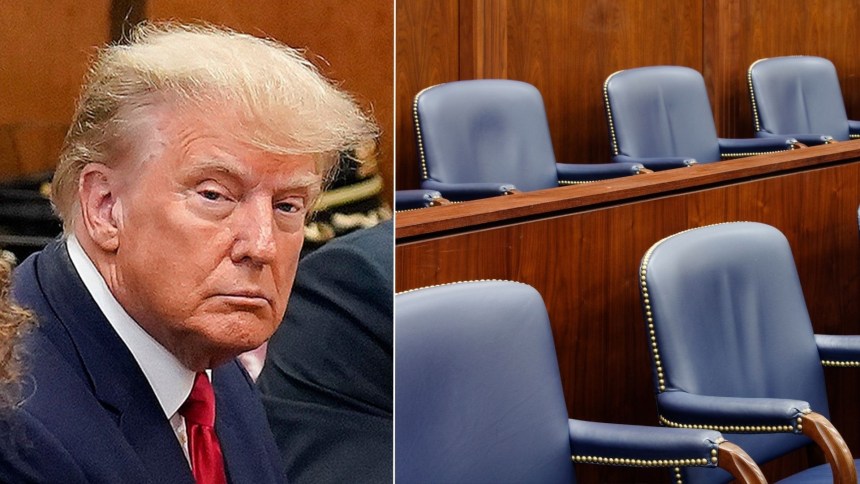
The twice-impeached former president of the United States, Donald Trump, begins the first of his four criminal trials on Monday. He faces 34 class E felony counts of falsification of business records in the first degree, and if convicted of one of those felonies, he could be looking at a maximum sentence of four years in state prison.
Approximately 6,000 jurors have been subpoenaed to appear for jury duty this week in the Manhattan Criminal Courts, with about 1,500 being called to appear Monday to participate in the jury selection process. According to the New York State Unified Court System, they were “randomly selected from lists of registered voters, holders of drivers’ licenses or ID’s issued by the Division of Motor Vehicles, New York State income tax filers, recipients of unemployment insurance or family assistance, and from volunteers.” Prosecutors for the Manhattan district attorney’s office and Trump’s lawyers will question these prospective jurors, and, with some time, some legal prowess and some luck, a jury of 12 of Trump’s peers will be selected to sit in judgment of him and render a unanimous verdict of guilty or not guilty.
Approximately 6,000 jurors have been subpoenaed to appear for jury duty this week in the Manhattan Criminal Courts, with about 1,500 being called to appear Monday to participate in the jury selection process.
The presiding judge, Juan Merchan, last week released to the public the seven-page juror questionnaire that will be used in Trump’s trial. It consists of 42 questions, several of which include multiple sub-questions. Some people will be excused initially for things like medical reasons and language barriers. And some will be excused from the outset because they immediately self-identify that they cannot serve because they cannot be fair and impartial to either the prosecution or the defense.Jury selection, also known as voir dire (which means “to speak the truth”), is a part of the jury trial process that often gets short shrift in terms of coverage and attention. It’s not as spicy as cross-examination or closing arguments. You rarely see jury selection depicted in movies or TV, because it can be time-consuming and hypertechnical. But it’s not hyperbolic to say jury selection is often the most important part of a trial. Picking the “right jury” is the key to getting the verdict you want. And if you fail to pick the right jury, then regardless of how much experience you have, how much you prepare your examination questions, how many times you loudly pound your hand on counsel’s table, you go into jury deliberations with one hand tied behind your back.

So, what kind of jury is Trump’s legal team hoping to seat? Ideal jurors for Trump’s defense are those who consider themselves true-blue Trump supporters, squarely in the MAGA camp, if you will. The jurors who believe that Trump is being politically persecuted or, in this case, politically prosecuted for daring to drain the swamp. Trump’s defense team would benefit from jurors who think that this case is a nothingburger over money given to a washed-up porn star. People inclined to believe that all of the prosecution’s witnesses are liars and that the biggest liar of them all is Michael Cohen, Trump’s former fixer and personal attorney. They will believe that the Manhattan DA’s office, just like the Justice Department, has been politicized by the Biden administration to unfairly go after Trump and Trump loyalists. Trump’s lawyers will want a jury composed of people who believe that he is immune from criminal prosecution and that this case never should have been brought in the first place. Favorable Trump jurors will believe that Merchan should have recused himself months ago because his daughter works at a company that provides support to Democratic politicians. They will think that anything the judge tells them is not to be believed, so they will ignore his instructions.


All lawyers can read prospective jurors’ body language and listen carefully to their answers and responses when questioned by both sides.
Those ideal Trump jurors, however, if they express their opinions with any fervency, will most assuredly be challenged for cause by the prosecution. Conversely, any prospective jurors who proclaim their belief, before hearing any evidence, that Trump is undoubtedly guilty will be challenged for cause by the defense. The juror questionnaire and the voir dire process are supposed to filter out potential jurors who militate to the extremes on both sides of the case. But all lawyers can read prospective jurors’ body language and listen carefully to their answers and responses when questioned by both sides. There is also an entire cottage industry of jury consultants who use social science, psychology and nonverbal cues to assist parties during voir dire. One or more of these jury consultants will be present at Trump’s counsel’s table during jury selection. And Trump’s defense team is going to have to rely heavily on its own abilities to read between the lines when prospective jurors are participating in voir dire. It will likely lean into education, employment and other socioeconomic indicators. This is a time when it might make sense to also lean into generalizations about groups of people to make a selection favorable to its case.
However, if a lawyer seat people who lie during voir dire in order to get onto that jury because they have ulterior motives, you have sadly got a process that is rigged for the wrong outcome from the get-go. In some cases, stealth jurors make it onto a jury, people intentionally hiding or lying about their true beliefs or feelings about a party or an issue in order to influence a decision. Both sides will have the opportunity to scour a prospective juror’s social media history and online footprint to confirm they were telling the truth during voir dire. If a rogue juror gets seated and then the truth ultimately is discovered about their background or opinions, that juror will be dismissed (and can sometimes face prosecution or contempt of court) and one of the six alternates will be seated in their place.As happens all cases, but especially in with ultra-high-profile cases like this one, jurors who are selected for service will be ordered by Merchan not to read, listen to or watch any media that covers the case or discuss the case with anyone, including family members and friends. These jurors will have to self-silo themselves from the outside world of news about this case and trial.
However, and despite the expanded gag order imposed upon him, once Trump is outside of the courtroom he is likely to fall into his routine of invectives and his barrage of attacks on the prosecution, witnesses, and the judge. In this case, Trump cannot attack the jurors, whose names will not be publicly disclosed per Merchan’s order. Attacking the jurors would also be simply shooting himself in the foot. These 12 New Yorkers are sitting in judgment of him and he would be wise to refrain from criticizing their service.
But on Monday, we begin at the beginning with hundreds of New Yorkers who have been called to do their civic duty. Hopefully, enough of these prospective jurors will speak the truth during voir dire for the first criminal trial of a former president of the United States.

Katie S. Phang
Katie S. Phang is the host of "The Katie Phang Show," which airs Saturdays at 12 p.m. ET on MSNBC. She is a legal contributor for NBC News and MSNBC based in Miami. She leverages her significant trial attorney experience to provide analysis and commentary on the latest legal issues.