







UPDATE (June 7, 2023, 7:45 a.m. ET): This story has been updated to reflect Mike Pence’s official campaign launch via video on Wednesday morning.
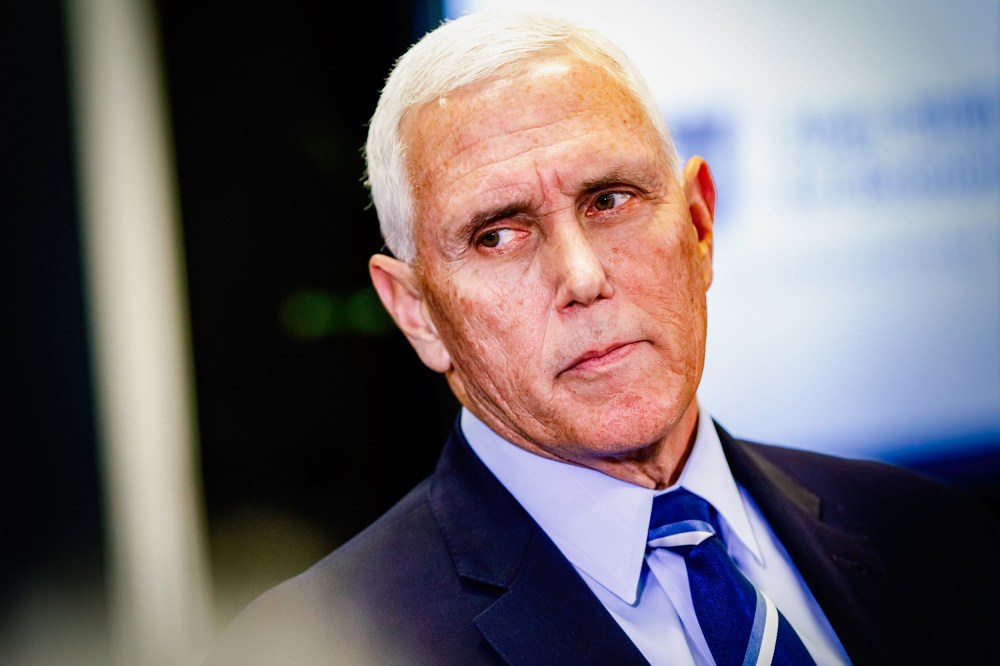
Former Vice President Mike Pence officially kicked off his candidacy for the 2024 Republican presidential nomination on Wednesday morning with a video posted across social media. In the run-up to his announcement, Pence has cast himself in the mold of another influential Republican president — but not the one he served under as vice president.
Pence wants us to associate him not with the norm-breaking presidency of Donald Trump but rather with the earlier version of Republicanism exemplified by Ronald Reagan. This isn’t exactly an attempt at moderation; he embraces cuts to popular entitlement programs, for example. But in many of his disagreements with Trump and Florida Gov. Ron DeSantis, Pence’s views are in the direction of more mainstream Republican politics: backing Ukraine in the conflict with Russia, reestablishing constitutional principles and distancing himself from the growing populist wing in the party.
Pence, in other words, is trying to move past Trump by moving backward.
Pence, in other words, is trying to move past Trump by moving backward. This strategy is akin to a pattern we often see with parties that have been underperforming — adopting the label of “new” or “modern” in concert with a move to the center. Political parties often present ideological shifts in terms of time. In the 1950s, moderate Republicans like Thomas Dewey and Dwight Eisenhower promoted a “modern” vision of Republicanism, which accepted some New Deal principles, but put a Republican spin on those ideas and sought to slow the growth of government. Their more conservative opponents favored a backward-looking revival of the party of Coolidge, Harding and Hoover.
In the 1990s, after his party lost three consecutive presidential races, Bill Clinton identified himself as a “new kind of Democrat,” who would abandon the “big government” of the New Deal and oppose “reverse discrimination” alongside racial injustice.
The benefits of hybrid, moderating ideologies have proved fleeting, however. As political scientist Stephen Skowronek notes, these leaders enjoy considerable political success, but struggle to pass on the presidency to a chosen successor, and thus do not cement these center-reaching ideological legacies in their own parties. And it’s not clear that these presidents remake their parties fully according to their ideological visions, though their ideas can have lasting power.
Pence’s call to look backward speaks to a different impulse in Republican politics — to try to recreate a point in history (or mythology), revisiting past greatness and restoring core values. The Republican glory days sometimes evoke the American founding, sometimes the period before the New Deal and the growth of the federal government, and more recently the Reagan era. No one, of course, has done more to popularize this ideologically tinged nostalgia than Trump, whose “Make America great again” slogan has come to characterize his movement and symbolize a country whose social structure was more hierarchical and less inclusive. But despite his slogan, Trump’s claims were often removed from history. He broke with modern Republican norms by mostly neglecting to talk about Reagan, to the point that some commentators identified Trump’s nomination and election as the end of the Reagan era.


Pence is trying to revive it. The tricky thing, obviously, about trying to revive a bygone era is that the context has shifted. Reagan’s ideas and coalition didn’t emerge in a vacuum; they happened in response to the economic struggles of the 1970s, the shifting cultural terrain, backlashes to the civil rights and anti-poverty movements of the 1960s and the Cold War. The economic, cultural and global situations are very different now.
To make a convincing case for a return to Reaganism, Pence needs to explain how its tenets are still relevant more than four decades later.
Most other Republican candidates today seem to elide this distinction between the Reagan and Trump factions within the party. Few explicitly challenge Trump’s place in the party, with most instead acting as though their campaign only has a real chance at victory if Trump is somehow removed from the campaign by other (presumably judicial) forces. Trump’s most direct competitor, Ron DeSantis, has campaigned on a vision that is largely Trump’s agitations against “wokeness” and “the left” turned up to 11. His high-profile fight with Disney — a massive corporation and a manufacturer of idyllic entertaining visions in Reagan’s time as well as now — is hardly Reagan-like.
To make a convincing case for a return to Reaganism, Pence needs to explain how its tenets are still relevant more than four decades later. When we look at different parts of the Republican coalition, there’s actually a case for where Pence’s views might match some important groups better than Trump’s do: he’s much more conservative on abortion, saying that “we must not rest” until abortion is outlawed in every state. These stances could appeal to anti-abortion activists dissatisfied with calls for, say, a 12- or 15-week ban. Pence’s break with Trump on Russia and Ukraine might also appeal to the foreign policy hawks frequently dismayed by the last administration.

But it’s not just about Pence’s stances. As The Bulwark’s Sarah Longwell notes, Republican primary voters are thinking in terms of time — before and after Trump in 2016. A challenge to Trump requires staking a position in that timeline. If this is the main issue, then Pence might have the worst of both worlds. Before Trump chose him as a running mate, Pence was a fixture of the Republican establishment, having served in Congress and as Indiana’s governor. But his undeniable connection to Trump and his culture war commitments keep him from having a realistic case for building a newer, broader coalition. When it comes to positioning himself in time, Pence might just be stuck.
Nevertheless, politicians have adapted the Reagan playbook in the past. In his first run for the presidency in 2000, George W. Bush had a particular knack for articulating and extending Reagan’s optimistic vision, and signaling support to the traditional foreign policy and evangelical elites in the party without sounding particularly extreme. It’s not clear that this kind of equivocation is possible in today’s politics. But Pence seems determined to try.

Julia Azari
Julia Azari is a professor in the Department of Political Science at Marquette University and a co-host of the "Politics in Question" podcast. Follow her Substack at https://juliaazari.substack.com.
Seth Masket
Seth Masket is a professor of political science and director of the Center on American Politics at the University of Denver. Follow his Substack at https://smotus.substack.com/.