






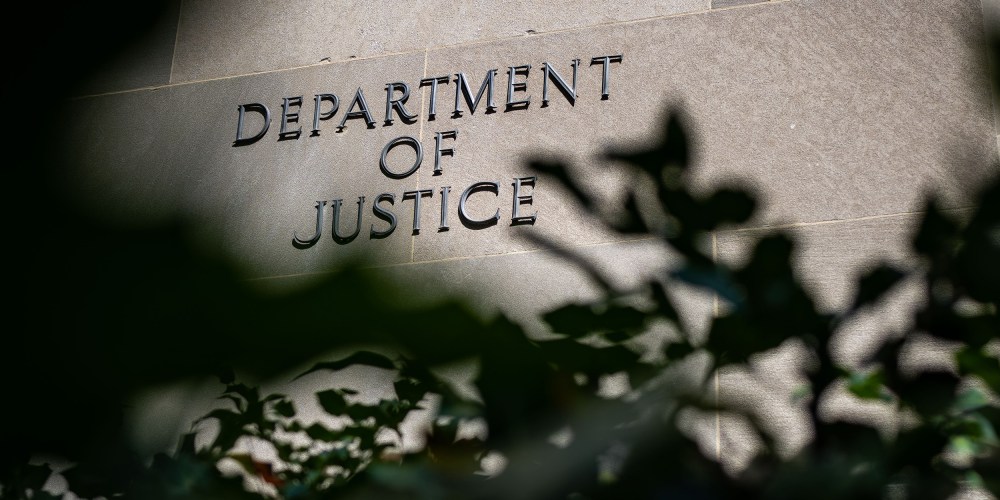
After the Department of Justice’s 36-page response to former President Donald Trump’s request for a special master to review material the FBI seized from his home, we could be inching close to someone, maybe Trump himself, being charged with obstruction of justice. Tuesday’s well-crafted objections to Trump’s request constitute a simple, yet persuasive, smackdown of the Trump team’s flawed legal logic. There were a number of eyebrow-raising revelations by DOJ, but more important was the department’s subtle but sustained theme of obstruction.
We appear to be inching close to someone, maybe Trump himself, being charged with obstruction of justice.
In addition to learning that the FBI search uncovered 100 more classified documents than Trump had already turned over and that the sensitivity of those documents was so high FBI agents executing the search warrant didn’t all have the required clearances to handle them, we got even more evidence that the government suspects there have been attempts to obstruct its investigation.
The prospect of obstruction charges isn’t new. On the face of the warrant executed Aug. 8, investigators listed three criminal statutes they had probable cause to believe had been violated. One of those laws is 18 USC 1519: “Destruction, alteration, or falsification of records in federal investigations and bankruptcy.” A federal judge agreed with those investigators that there was probable cause to search Trump’s home and signed the warrant. A judge agreeing to a search warrant, though, doesn’t mean anything more than that.
A successful obstruction prosecution would require two things. First, proof that the accused knowingly concealed or destroyed records and, second, proof they did so to impede the work of an official agency. DOJ’s response filing provides us some insights into why the department thinks such thing has already happened. In fact, the filing lays out a kind of seven deadly sins pointing to obstruction. According to the DOJ:


- Trump and his team repeatedly chose not to turn over extremely classified government documents despite being officially advised the documents were not theirs and despite a subpoena ordering them to do so;
- one of Trump’s lawyers provided a written assertion that all relevant documents had been turned over after conducting a “diligent search.”
- someone on Trump’s team “explicitly prohibited government personnel from opening or looking inside any of the boxes that remained in the storage room” during service of the subpoena;
- “Government records were likely concealed and removed,” and the search discovered classified documents even within the drawers of Trump’s desk, and intermingled with personal items;
- “Efforts were likely taken to obstruct the government’s investigation”;
- the August search warrant, executed 17 months after Trump left office and after protracted negotiations, subpoenas, and a physical site visit, led to the recovery of over 100 additional classified documents, thereby confirming prior attestations were false;
- the government’s discovery of additional documents “calls into serious question the representations made in the June 3 certification and casts doubt on the extent of cooperation in this matter.”

The DOJ’s assertions seem to make a case for both the “knowing concealment” and the “intent to impede” requirements for obstruction. But if those elements are satisfied, who could be charged and based on what conduct? Well, The Washington Post reports that Trump attorney Christina Bobb told the newspaper that Trump lawyers showed federal officials the boxes in the storage room and that Jay Bratt, chief of the Justice Department’s Counterintelligence and Export Control Section, spent time looking through them. That sounds like a direct contradiction of the DOJ’s claim that Trump’s team denied a request from government officials to enter the storage room and check for documents.
The DOJ filing also takes issue with the claim that Trump declassified by “standing order” all the seized documents when he was president. DOJ points out that “neither counsel nor the custodian asserted that the former President had declassified the documents or asserted any claim of privilege.” Over a dozen former Trump officials have disputed the notion that there was a “standing order” to declassify whatever Trump wanted. That could mean that former Trump adviser Kash Patel is in trouble. It’s Patel who has claimed he can personally attest to Trump’s “standing order” defense. Time will tell who’s telling the truth, but if the FBI were to develop evidence that Patel and Trump conspired to concoct a phony standing order defense, then they could be charged.
After the search of Mar-a-Lago, Trump took to social media to claim that his lawyers had “cooperated fully.”
After the search of Mar-a-Lago, Trump took to social media to claim that his lawyers had “cooperated fully” and that “the government could have whatever they wanted, if we had it.” That appears to be inconsistent with the facts, and might even constitute an attempt to obstruct the investigation if his intent is to apply public pressure on DOJ. Trump has publicly repeated Patel’s assertion that he, Trump, declassified everything. Again, this could merely be free speech, or a deliberate attempt to convince others to go along with a ruse. But if Trump were to repeat a false story to investigators, then they could charge him with obstruction and more. Trump is no innocent bystander here. He can’t say that he had no idea all these documents were in his house. That’s because, as The New York Times reported citing multiple sources, Trump himself went through the boxes in late 2021.
Increasingly, it looks like Trump and others knew what he had, knew where it was, and knew not all of it had been returned. The questions they should now be asking themselves include, “How much more does DOJ know, and how many of us are going to be charged?”
