








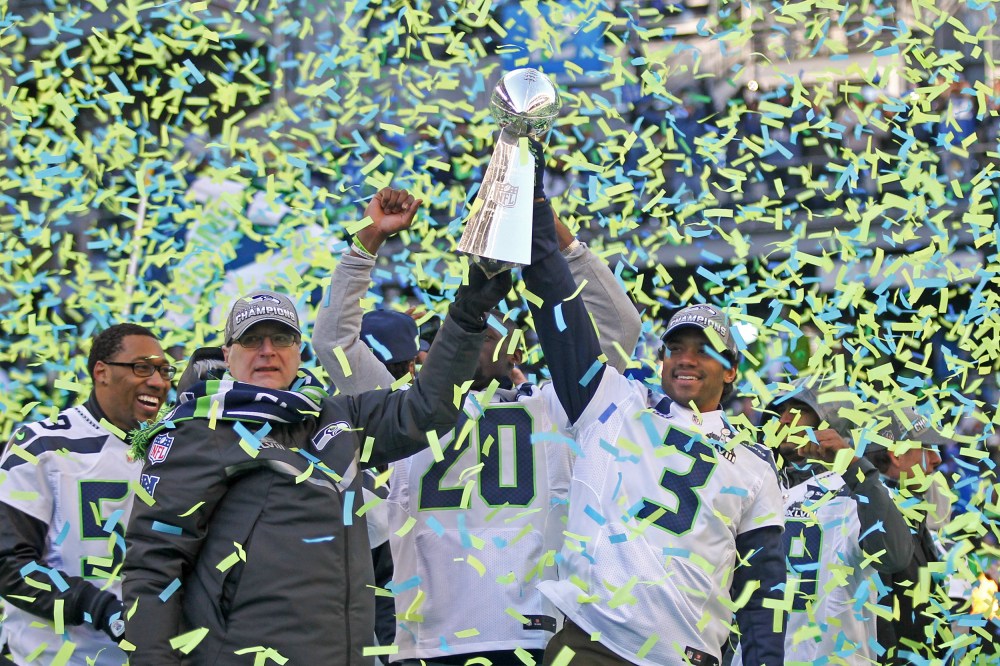
UPDATE (Feb. 8, 2026, 10:25 p.m. ET): On Sunday night, the Seattle Seahawks easily defeated the New England Patriots by a score of 29-13 to earn their second championship in franchise history.
There’s almost no good time for a sports fanatic to hear about the potential sale of their team, but it’s hard to imagine a worse time to hear it than right after that team earns a trip to the Super Bowl. So it is, though, for Seattle Seahawks fans, who have likely heard the whispers that whether their team wins or loses the Super Bowl against the New England Patriots on Sunday, the franchise could be put up for sale.
The betting person would do well to wager that the Seahawks will be sold soon, especially if the team wins Sunday.
“Could” may not be a strong enough word. The team has denied that it is up for sale at present, while acknowledging that it will be sold in the future. But the betting person would do well to wager that the Seahawks will be sold soon, especially if the team wins Sunday in San Francisco. And while there’s no way to know how Seattle fans might feel about a new owner, America as a whole might find reason to cheer because the late owner of the team, Microsoft co-founder Paul Allen, left explicit instructions that his assets be sold to fund a portfolio of charitable causes.
During his lifetime, he established and funded multiple philanthropic interests in his own name, giving seven- or -eight figure contributions to fight homelessness, fund the University of Washington’s School of Science and Engineering, combat the Ebola virus in West Africa, study artificial intelligence and other causes. And by ordering that his assets be sold, he made it known that he intended for that work to continue after his death. It’s a model we should hope that other billionaires, sports owners or otherwise, follow.
“Many years ago I decided to dedicate the majority of my fortune to philanthropy. I believe that those fortunate to achieve great wealth should put it to work for the good of humanity,” Allen wrote in a 2010 letter announcing his commitment to The Giving Pledge, an initiative under which some of the world’s richest individuals, including Bill Gates, the other Microsoft co-founder, and Warren Buffett, vowed to give away most of their personal fortunes, either while alive or posthumously. Allen, who bought the Seahawks in 1997, was reportedly worth between $20 billion and $30 billion when he died in 2018 of non-Hodgkins lymphoma. He was 65.
Think of the Seahawks as one of the most valuable items in a massive, staggered estate sale. In addition to the Seahawks, Allen also owned the NBA’s Portland Trail Blazers and MLS’ Seattle Sounders. Since his death, his Pacific northwestern sports empire has been in the control of his sister, Jody Allen, his estate’s trustee. She is the controlling owner of the Seahawks via an entity set up to hold his assets. Things are going swimmingly for the Seahawks under Jody Allen’s stewardship, so Seahawks fans might ask why the team would be sold now. They might be particularly nervous that as has been the case with other teams, a sale would portend a possible relocation.


But a Seahawks sale would have nothing to do with the kind of wrangling over stadium leases or the want of a new venue altogether, which typically precedes threats to move a team. There are, however, other reasons that the timing to sell may never be better.
There’s no hard data proving that a team’s value spikes after a Super Bowl win, but the extra attention doesn’t hurt.
First, a provision in the public funding arrangement for Lumen Field, the Seahawks’ stadium, that would have imposed a 10% fee on the sale of the team expired in May 2024. And Paul Allen’s estate is under pressure to sell the team because its ownership structure allegedly violates NFL rules. The Wall Street Journal reported late last month that the patience from other owners and league had grown thin. Citing people familiar with the matter, the Journal reported that the Seahawks were fined $5 million for “being out of compliance with ownership requirements,” which the NFL denied.
There’s no hard data proving that a team’s value spikes after a Super Bowl win, but the extra attention it garners from ticket-and-jersey buying fans and more importantly, corporate sponsors, certainly doesn’t hurt. Then there’s the effect of the NFL’s 2024 approval of private equity firms owning as much as 10% stakes in its teams. No teams have been sold under the new arrangement, but private equity capital seems certain to flood in the next time a team does change hands.
The most recent sale in the NFL was the 2023 sale of the Washington Commanders to Josh Harris for a reported $6.05 billion; CNBC already pegs that team’s value at $7.4 billion, a 22.3% spike in just two years. And the Commanders aren’t even in the Super Bowl. In September, CNBC valued the Seahawks at $7 billion. If that’s the sale price, it would be the highest ever for an American sports team.
Seven billion dollars would provide shelter for lots of unhoused people. It’d fund a lot of crucial research on the ethics of AI, or fill some critical gaps left in funding other types of scientific research that has been recently cut by the federal government.
Sooner or later, the Seahawks are headed for an ownership change, and the winds of change feel like they’re blowing in that direction already. But chin up, Seahawks fans. Whatever happens in Sunday’s game, you should rest easy knowing that your late owner’s generosity means the team’s sale will make life better for an untold number of people.

Keith Reed
Keith Reed is an award-winning journalist and a past senior editor at ESPN. His work has appeared in The Boston Globe, The Root, Vibe, Essence and elsewhere.