








Teyana Taylor, a Black woman actor, won the Golden Globe for best supporting actress earlier this month for her role as Perfidia Beverly Hills in “One Battle After Another.” On Thursday she was nominated for an Oscar for that same role in Paul Thomas Anderson’s action thriller-dark comedy about a far-left resistance group taking on the government. But even though Black women’s wins at the Oscars and Golden Globes have been few and far between, those of us who care about the representation of Black women on the big screen are justified in having mixed feelings about the role that’s getting Taylor such attention.
We can’t help being distressed by the one-dimensional Jezebel that Perfidia Beverly Hills is.
As much as we might want to join in on the “screaming and hollering” that Taylor says she did after winning the Golden Globe, we can’t help being distressed by the one-dimensional Jezebel that Perfidia Beverly Hills is. In the first 30 minutes of the almost three-hour movie, Perfidia is in at least five sexually charged scenes with her comrade and partner, Pat/Bob Ferguson (Leonardo DiCaprio), and her nemesis, Col. Lockjaw (Sean Penn).
The hypersexualized Black woman is one of the “controlling images” that Black feminist scholar Patricia Hills Collins describes as justifying the mistreatment of Black people. Such media representations are comforting for mainstream audiences because they are familiar and confirm their biases. Sadly, Hollywood keeps returning to them.
In the film, Perfidia is one of the leaders of the far-left armed group French 75, which is battling the white supremacist authoritarian U.S. regime along the U.S.-Mexico border, and finds itself locked in, well, one battle after another — for decades. Perfidia, a standout leader, gets a thrill from revolutionary violence. She finds guns “f–––ing fun” and bombs arousing.
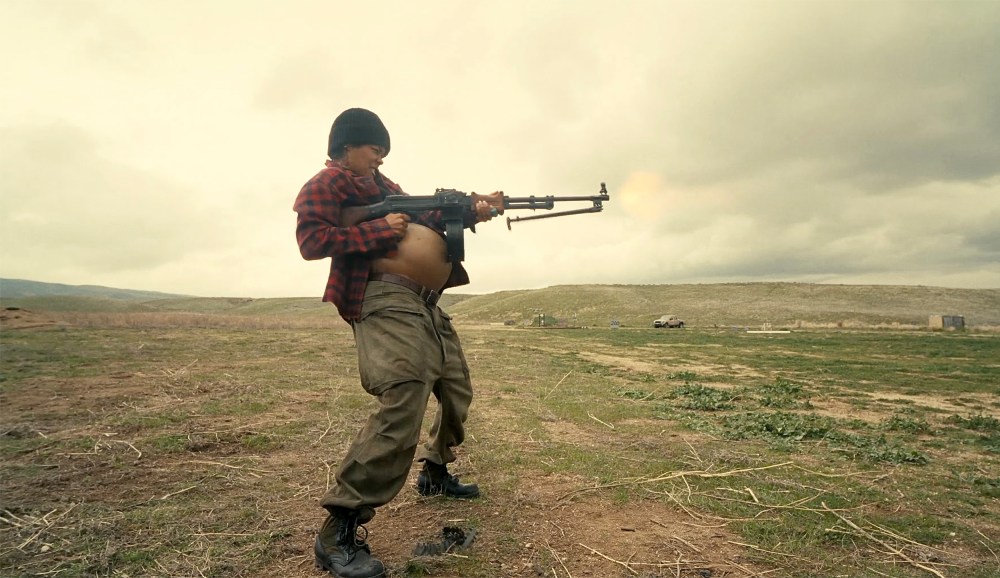
While the story of Perfidia drives the movie, the only thing we really know about her is that she is a Black woman who feels most alive when wielding a gun. An enduring image of the film shows her firing an automatic rifle while heavily pregnant. She has her shirt unbuttoned to expose her distended belly.

Upon realizing that Lockjaw is attracted to her, she toys with his desire. She teases him until he’s visibly aroused and then parades him in front of his fellow soldiers to humiliate him. They later meet in a hotel, where they both seem to enjoy her sexually humiliating him more. He will later refer to Taylor’s character as a “semen demon.” We’re meant to laugh at this comment, which says more about Lockjaw than Perfidia, but that doesn’t lessen the sting for some viewers.


It’s hard to imagine that Anderson and Taylor herself didn’t anticipate the outrage to this over-the-top depiction of a hypersexual Black woman. So, did Anderson write Perfidia as a one-dimensional Jezebel, or is that depiction meant to be a joke? It’s not clear, largely because we see so little of her. We get no backstory. We don’t even know if she’s really into her partner beyond her excitement over his bomb-making skills. Although the movie apparently means to show the importance of Black women as resistance fighters and as worthy opponents to men on both sides of the war, and though Perfidia is ostensibly a revolutionary, she’s got a thrill-seeking personality more animated by risk than social change.

After she gives birth to a daughter who was conceived during the rendezvous with Lockjaw and suffers postpartum depression, she leaves her daughter and her partner, and the country, and never appears in the film again.
The biracial Black daughter she leaves behind is essentially her mother’s foil. She becomes the good girl, the good fighter who becomes dedicated to the liberation struggle with love and virtue, not lust and adrenaline. Those are the two primary representations of Black women in the film: pathological adult woman and her innocent child.
In the end, it’s not clear whether Anderson is playing with racist stereotypes or promoting them. It seems like he’s doing both, sometimes unintentionally. Responding to criticism about her character, Taylor said she doesn’t see Perfidia as a victim or a stereotype but as a woman who uses her sexuality as a form of erotic power to get what she wants. Yet, in large part because she’s a caricature and not a character, it’s not clear what Perfidia wants or why she wants it.
Taylor has already proved she’s a talented actor, and she certainly delivered some of the most memorable moments in “One Battle After Another.” I won’t be mad if she wins her first Oscar for her portrayal of Perfidia because, in line with what Issa Rae famously said, I’m almost always rooting for everybody Black. But I maintain the right to be mad that Hollywood keeps giving Black women roles that perpetuate troubling stereotypes about us.

Robyn Autry
Robyn Autry is a sociology professor and director of the Center for the Study of Public Life at Wesleyan University. She is the author of “Desegregating the Past: The Public Life of Memory in the U.S. and South Africa.”