








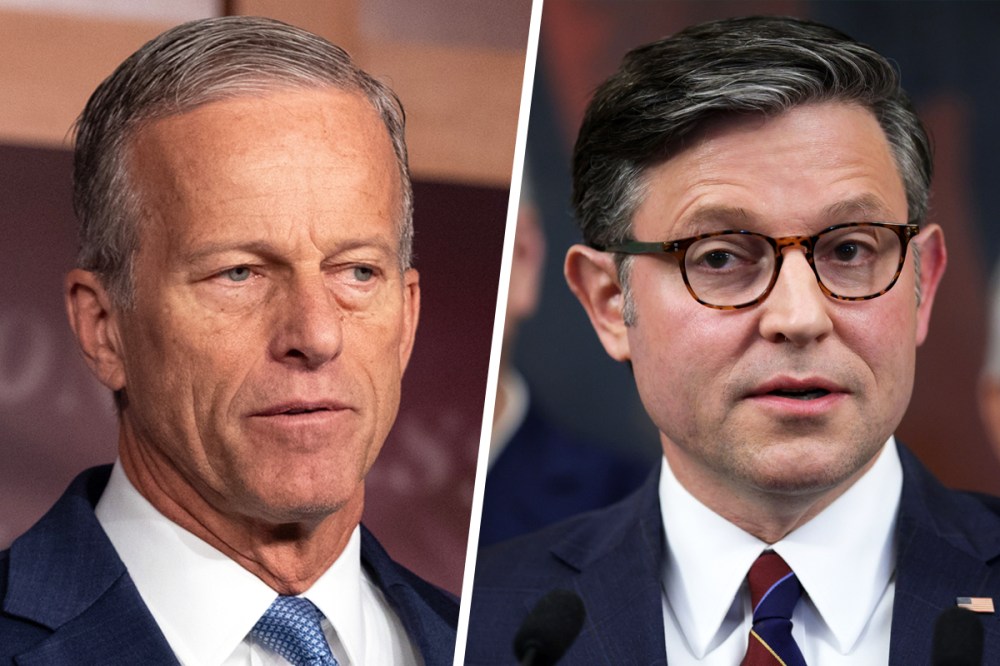
As the Senate speedily and unanimously approved a bill Tuesday to compel the Department of Justice to release all files related to Jeffrey Epstein — the dramatic finale to months of partisan maneuvering over the records — another conflict was brewing on Capitol Hill between the two top GOP leaders: Speaker Mike Johnson of Louisiana and Senate Majority Leader John Thune of South Dakota.
Johnson entered the day believing that after the House passed the Epstein Files Transparency Act, the Senate would make a series of changes to the bill. “If and when it is processed in the Senate, which is no certainty,” Johnson said, suggesting his understanding was that senators might just shove the bill in a filing cabinet.
Those assurances, Johnson suggested on Tuesday morning, came from conversations he had with Thune over the weekend.
But within hours of the House’s 427–1 vote, Thune and Senate Republicans approved the bill — with no changes.

After such an overwhelming House vote, Thune said, “the conclusion was” the Senate would simply move the bill as is. “I’m not sure there’s going to be a need for or desire for an amendment process over here,” he told reporters.
Thune’s comments blindsided Johnson. The speaker had repeatedly raised concerns about the scope of the Epstein files release, saying that he wanted to ensure the victims’ privacy and that the Justice Department wouldn’t release child sex abuse information. (The bill gives the attorney general the explicit discretion to redact that sort of information.)
But rather than the Senate “methodically” amending the legislation, as Johnson had put it on Tuesday morning, the speaker and his members watched the Senate pass the bill in minutes, without touching it.
The outcome left Johnson, by his own admission, “deeply disappointed” and “frustrated with the process.”
“But,” he told reporters on Tuesday night, “I trust Leader Thune.”
Johnson and Thune have spent the better part of this Congress marching in lockstep. Johnson has described his relationship with Thune as an “intense fellowship” to allies over the course of the last year.
Apparently there’s no agreement between Speaker Johnson and Leader Thune that the Senate Republicans will take up that provision, which reinforces the point that everything that House Republicans do is for show.”
House Minority Leader Hakeem Jeffries, D-N.Y.
The fellowship culminated in the GOP’s reconciliation bill this summer. The two top Republicans meet once a week, a source familiar with their relationship who was not authorized to speak on the record told MS NOW, and this source said they continue to have a great relationship.
But in recent weeks, there have been some unmistakable moments of friction — not that it takes much to touch off the rivalry between the House and Senate.
During the historically long government shutdown, Johnson kept his chamber out of town for weeks, a decision Thune never decried, but also never publicly supported.
The eventual bipartisan deal that reopened the government included a controversial, member-negotiated provision that would allow Republican senators to sue the Department of Justice for having accessed their phone records during an investigation into the efforts to overturn the 2020 election. It was another decision that caught Johnson flat-footed and drew his ire.
The speaker told reporters he was “very angry” and “surprised” by the provision. He told Thune he wanted it stripped out, and he expected the Senate to heed that call.
But as recently as Wednesday morning, Thune made it sound like stripping those provisions was unlikely.

“The House isn’t implicated in what we did,” Thune said, defending the language and saying he didn’t yet know how the Senate would handle a bill meant to roll back those provisions. The House has not yet moved on such legislation.
But House Minority Leader Hakeem Jeffries, D-N.Y., was quick to point out the disagreement to reporters on Wednesday morning.
“Apparently, there’s no agreement between Speaker Johnson and Leader Thune that the Senate Republicans will take up that provision, which reinforces the point that everything that House Republicans do is for show,” Jeffries said.
And then there was Thune’s rejection of Johnson’s plea to amend the Epstein bill, a request he dispensed with almost as quickly as the Senate processed the legislation.
“I am deeply disappointed in this outcome,” Johnson told MS NOW on Tuesday night, shortly after the upper chamber approved the legislation, his confidence that Thune would address his “deep concerns” about the bill now dashed. That Johnson was among the 427 House members to vote for the bill — without amendments — was not lost to those on the Senate side.
These moments, which mark rare signs of misalignment between the top Republicans, come ahead of a tense, high-stakes negotiation over full-year government funding efforts and a looming attempt to overhaul health care. Thune promised that vote to Democrats who lent their support to reopen the government, but Johnson has refused to promise he’d take up similar legislation in his chamber.
Several House Republicans, who spoke to MS NOW on the condition of anonymity to discuss the sensitive situation, acknowledged that those issues would be thorny even without the perception of a rift.
“Tell me how this helps?” one senior House Republican asked rhetorically.
A GOP lawmaker close to Republican leadership warned that “there’s been an erosion” of Thune’s capital among House Republicans because of these recent actions.
“Johnson knows to get anything done, Thune has to be trusted and respected on the House side. There’s been a bit of a hit to that,” the second GOP lawmaker said. “So I assume the speaker is hopeful Thune can stand and deliver when needed here in the months to come.”

Thune spoke to the recent disagreements on Wednesday, downplaying them as “different ways of doing things” between the two chambers.
“At times, there may be, as I said, slight differences of opinion about … how to get things done,” Thune said. “But I think, for the most part, I would say we have an incredibly strong working relationship and work closely with the White House, and I think that’s what’s enabled a lot of success.”
Ultimately — however real or perceived the rift — it may be the personal that overcomes the politics.
Johnson is known on Capitol Hill for his mild-mannered demeanor, preferring to refer to himself as a “happy warrior.” As cliched as that phrase is in politics, it’s a departure from some previous Republican speakers, who were quick to engage in heated rhetoric and hard-line tactics.
But just as sources close to the speaker acknowledged to MS NOW that Johnson isn’t thrilled by some of Thune’s recent actions, they also said not to expect this crack to crumble their relationship as it might have with other GOP leaders.
“His pissed is a ‘gee golly.’ He’s not throwing f-bombs like others,” a third House Republican noted.
And the senior House Republican close to GOP leadership told MS NOW that if it were anybody else but Johnson, the relationship would be tarnished.
“But just because of his demeanor — he is truly a man of faith and forgives and moves on,” this House Republican continued. “I mean, it’s the craziest thing, but he truly cares about how to make this body work, and if the House and Senate are at odds with each other, it doesn’t work real well.”
Syedah Asghar contributed to this report.

Ali Vitali is MS NOW's senior congressional correspondent and the host of "Way Too Early." She is the author of "Electable: Why America Hasn’t Put a Woman in the White House … Yet."

Mychael Schnell is a reporter for MS NOW.